
Cryptocurrencies and Inheritance: Who Will Get Your Bitcoin and How Can They Access It?
Imagine someone who invested regularly throughout their life. Part of their savings is in Apple shares, part in Bitcoin. They bought both investments for the long term and both are worth a considerable amount today. But when they die unexpectedly, their family discovers that there is a fundamental difference between them. The shares are held in an investment account with a broker. The Bitcoin is stored in their own hardware wallet, which nobody else can access.
From a legal point of view, both can form part of the estate. However, while for shares there is an institution that keeps records and can cooperate with the transfer once the necessary documents are provided, for a private Bitcoin wallet there is no such central point. If the family cannot obtain the necessary keys, the assets may be effectively inaccessible, even though they legally belong to them.
Inheriting cryptocurrencies is therefore interesting precisely because it connects two different questions. Who do the assets belong to? And who is able to control them technically? With traditional investments, these questions tend to be linked through banks, brokers and legal records. With cryptocurrencies, they can become completely separated.
What it actually means to inherit an investment
An inheritance is not just taking over money in a bank account or a house. The estate can also include securities, shares in companies, receivables and other property rights. In the modern world, this also includes digital assets, if under the applicable law they are the property of the deceased.
Imagine that the deceased owned ten Apple shares, one bitcoin and a certain amount of stablecoins. From an economic point of view, this is an investment portfolio. From a legal point of view, all these assets can be the subject of probate proceedings. From a technical point of view, however, the way they are handed over may be completely different.
That is why it is necessary to distinguish three steps: discovering that the assets exist, determining who inherits them, and actually gaining control over them. For some assets, the very first step may be the hardest. For others, it is the last one.
How traditional shares are inherited
When an investor buys shares through a broker, they usually hold them in a system that keeps ongoing records. These include the client's account, the number of securities and the trading history. The shares do not necessarily have to be registered directly in the investor's name in the company's register of shareholders; ownership and the related entitlements may be held through several institutions.
If the investor dies, their assets can be traced through statements, contracts and information from financial institutions. In Czech probate proceedings, the deceased's assets are identified by a notary acting as court commissioner. If the broker is known, they can be contacted and asked for the necessary documents. After the proceedings are concluded, the securities are then transferred or settled according to the applicable rules.
The process is not always simple. A foreign broker may require translations of documents, identification of the heir and further verification. If the family does not even know where the deceased had an account, tracing it can be complicated. Nevertheless, there is an important advantage: the investment infrastructure allows the rightful heir to prove their status and ask the institution for cooperation.
At this point, traditional shares differ significantly from Bitcoin held in your own wallet. It is not that one can be inherited and the other cannot. The difference lies in who can practically carry out the transfer and under what conditions.

Bitcoin: an asset without a custodian who could release it
Bitcoin was created as a system that makes it possible to transfer digital value without the need for a central authority. Records of bitcoins are kept on the blockchain. The ability to create valid transactions, however, is tied to cryptographic keys. If an investor holds Bitcoin in their own wallet, they alone are responsible for controlling these keys.
It is often said that Bitcoin is stored on a hardware wallet. Technically, this is a simplification. Bitcoin exists as a record in the blockchain network; the hardware wallet protects the keys used to manage it. Likewise, a seed phrase usually makes it possible to derive the necessary keys again and restore access.
After the owner's death, the blockchain does not stop working and the Bitcoin does not disappear. But if nobody has the keys or the recovery details, there may be no way to transfer the funds. A notary can determine the heir and a court can confirm their rights, but neither of these decisions can, on its own, create a missing private key.
This brings us to the paradox of decentralisation. While the investor is alive, independence from intermediaries can be a great advantage. After their death, however, the same independence can turn into an obstacle for the family.
Cryptocurrencies on an exchange are a different case
Not all cryptocurrencies are stored in a self-custody wallet. A large share of investors use cryptocurrency exchanges and other service providers that hold assets in custody. With such an account, the situation can be more similar to that of a traditional broker. The provider knows the client's identity, keeps records of their balances and may have an established procedure in the event of death.
For example, Coinbase describes in its public help centre a process in which authorised persons submit a death certificate, probate documents, proof of identity and instructions for transferring the assets. The specific requirements may vary by country and service. What matters is that the assets are not transferred simply by sharing the deceased's password, but through verification of the legal claim.
This does not mean, however, that every exchange account is automatically easy to inherit. The operator may have different terms, the account may be unknown, documentation may be missing and a foreign jurisdiction may complicate the procedure. The family should therefore at least know which platforms the deceased used.
In practice, there are thus two different types of crypto inheritance. With custody through a provider, the main issues are identifying the owner, documentation and the institution's cooperation. With a self-custody wallet, besides the legal aspect, securely obtaining cryptographic access is also essential.
When the inheritance of digital assets started to be addressed
People have inherited property for thousands of years. With the arrival of internet services, however, a new question arose: what happens to a person's e-mail, photos, cloud storage or digital account after their death? The problem did not begin with Bitcoin. Cryptocurrencies merely shifted it into a situation where digital access can mean direct control over considerable financial value.
After Bitcoin was launched in 2009, private wallets were often managed by technically skilled users and systematic estate planning was not a major topic. As the price of Bitcoin rose and the market expanded, however, more and more people began to consider how to pass on not only ownership, but also access credentials.
Significant steps also came from outside the cryptocurrency space. In the USA, the model law RUFADAA was created in 2015, governing access to digital assets and communications by persons managing the property of others. In Germany, in 2018, the Federal Court of Justice (BGH) ruled on a landmark dispute over heirs' access to a Facebook account. It was not about Bitcoin, but it was an important signal that digital accounts can be part of a broader legal settlement of an estate.
In Europe, further developments brought a growing emphasis on regulating cryptocurrency service providers. Greater client identification and record-keeping at regulated companies can help heirs trace assets. However, it does not replace the rules of inheritance law, and it certainly cannot restore lost keys to a private wallet.
How inheriting cryptocurrencies works in the Czech Republic
In the Czech Republic, Bitcoin and other common crypto-assets are not excluded from inheritance just because they are neither bank deposits nor traditional securities. If they represent property of the deceased, they belong to the estate and are subject to the general rules of inheritance law.
In probate proceedings, it is essential to establish which assets the deceased owned, who is to inherit them and what their value was for the purposes of the proceedings. With cryptocurrencies, it can be difficult to prove their existence and ownership. A public blockchain address alone does not reveal who its legal owner is. Exchange statements, purchase records, transaction history and other documents can help.
Cryptocurrencies can also change in price quickly. For valuing the estate, it is therefore important to use the relevant decisive date and a credible source of market value; you cannot simply take any later rate from an investment app.
The acquisition of an inheritance itself is generally exempt from income tax in the Czech Republic. However, this does not mean that every subsequent dealing with inherited crypto-assets will automatically be tax-free. Inheriting and a subsequent sale are two different events. For significant exempt income, a separate reporting obligation may also arise.
Since 15 February 2025, the Czech Income Tax Act has also contained rules for exempting certain income from the transfer of crypto-assets. For selected crypto-assets, a three-year holding test and a value test apply; the rules have exceptions and limitations. When inheriting from a relative in the direct line or from a spouse, under specified conditions the period during which the deceased owned the asset also counts towards the three-year period. In 2026, a limit of CZK 40 million for the relevant exemption still applies to crypto-assets, whereas for securities this limit was abolished as of 1 January 2026.
Example: A father bought Bitcoin in 2020 and his son inherits it after his father's death in 2026. If the asset and the situation meet the statutory conditions, the father's holding period may also count for the son when he later sells it. This is a significant difference from the idea that the heir always has to start counting a new three years. The specific tax outcome, however, will also be affected by other conditions and any limitations on the exemption.
Germany: similar inheritance principles, different tax rules
In Germany, inheritance law is based on the Civil Code, the BGB. The basic idea is similar to that in the Czech Republic: the deceased's property position passes to the heirs according to the applicable rules. This can also include cryptocurrencies. But even a German inheritance decision will not solve a situation where the family has no access to the private keys.
A significant difference lies in taxes. Germany has a separate inheritance and gift tax. This does not mean that every inheritance is taxed. The law works with tax-free allowances depending on the family relationship and with other conditions. For example, the basic personal allowance for a spouse or registered partner is 500,000 euros and for a child 400,000 euros. Only above the relevant thresholds, and after taking other rules into account, can tax arise.
Imagine two families with cryptocurrency portfolios of the same size. One is dealing with the inheritance in the Czech Republic, the other in Germany. The value of the portfolio may be the same, and so may the access problems, but the tax consequences of acquiring the inheritance may differ. This shows that a global blockchain does not mean globally uniform inheritance law.
United States: digital inheritance and differing rules in individual states
In the United States, the situation has several layers. Probate and estate administration are largely governed by the law of individual states. At the same time, there are federal tax rules as well as special legislation on access to digital assets.
The model law RUFADAA, published in 2015, deals with the powers of estate administrators and other authorised persons when dealing with operators of digital services. Its existence, however, does not mean that an administrator could recover lost private keys to Bitcoin. It applies mainly where there is a service provider that can make certain data or an account accessible under statutory rules.
The American tax system also distinguishes between any estate tax and the later taxation of the sale of the assets. For inherited assets, for federal capital gains tax purposes, a new tax basis is generally set according to the market price on the date of death, or on another valuation date permitted by law. This is called step-up in basis. For heirs, this can be significant if the value of the asset rose substantially during the deceased's lifetime.
Example: An investor bought Bitcoin for 10,000 dollars. On the day of their death, the Bitcoin was worth 90,000 dollars. If the usual rule of market value on the date of death is applied to the particular inheritance, the starting tax value for the purposes of a subsequent sale will generally be 90,000 dollars, not the original 10,000. This does not automatically mean zero taxes in every case: there are conditions, exceptions and possible federal and state obligations.
The difference between the Czech holding period test and the American adjustment of the tax basis is a good example of how countries can address the same situation with different tax tools.

What if a Czech citizen lives in Germany and holds cryptocurrencies on an American exchange
Imagine a Czech citizen who has lived in Germany for many years, has a family there and invests through a foreign cryptocurrency platform. Their children have Czech citizenship and part of the family still lives in the Czech Republic. Which country will handle the inheritance?
In the European Union, there is the Succession Regulation, Regulation (EU) No 650/2012, which has applied since 17 August 2015 in the participating Member States. The basic rule is the deceased's habitual residence at the time of death. Under certain conditions, a person may choose the law of the state of their nationality for their succession. The regulation also created the European Certificate of Succession, which can help prove the status of an heir in another Member State.
So if a Czech citizen lives in Germany long-term, it should not be automatically assumed that the entire proceedings will follow Czech law just because of their passport. The specific circumstances and any valid choice of law are what matter. An American exchange may, moreover, have its own procedures for recognising documents and granting access to the account.
It is even more important to distinguish inheritance law from tax law. The European Succession Regulation does not harmonise tax matters. So one thing is which law determines the heir. Another is where and under what conditions tax obligations may arise.
What happens to Bitcoin when nobody knows the seed phrase
Imagine that the family finds a hardware wallet. They know the deceased used it to manage Bitcoin, but they do not know the PIN or the recovery seed phrase. The device itself is not the same as access to the funds. If the keys are securely backed up elsewhere, recovery may be possible. If they are not available at all, a transfer may be practically impossible.
A public blockchain makes it possible to track the balances and history of a specific address, if we know it. However, it does not contain any central function that would assign a new key to an heir on the basis of a death certificate or a court decision. Nor is there an operator of the Bitcoin network that exists as a single company you could call.
People sometimes say that lost bitcoins have been destroyed. It is more accurate to say that they remain recorded on the blockchain, but without the necessary key nobody can spend them. From an economic point of view, they may thus be removed from circulation for the long term.
This situation cannot be solved by the simple advice of putting the seed phrase into an ordinary e-mail or a shared document. While the family could gain access that way, so could an attacker while the owner is still alive.
Can Bitcoin be inherited by more than one person
Imagine that an investor owns two bitcoins and has two children. At first glance, a simple split suggests itself: each child gets one bitcoin. In practice, however, there may be other assets, liabilities, differences in the size of inheritance shares, or one heir may prefer to receive money instead.
Bitcoin can be divided into very small units. From a technical point of view, it is therefore no problem to send each heir a different amount. What is crucial, however, is that such a transfer takes place only in accordance with the applicable probate procedure and that it is clear who is allowed to carry it out.
With self-custody of cryptocurrencies, there is also the question of security during the settlement. If only one person knows the seed phrase, they can control the funds without the consent of the others. However, the technical ability to make a transfer does not mean that this person has the legal authority to do so. Inheritance therefore requires not only good keys, but also good rules.
How to prepare for the inheritance of cryptocurrencies
The most sensible time to deal with a digital inheritance is not after the owner's death, but while they can still explain themselves what they own and how the assets are secured. A prepared plan does not have to mean giving the family unlimited access today.
The foundation is an overview of assets and services. The family or a designated administrator should know that there are accounts with specific providers, self-custody wallets and possibly other digital assets. It is also useful to keep the acquisition history and documents for valuation or any tax assessment.
The second step is legal instructions. A will can determine who receives the assets, but on its own it does not replace a technical access plan. These two parts should build on each other. Security details are generally best kept separately from commonly accessible documents, with their handover arranged so that an unauthorised person cannot misuse them.
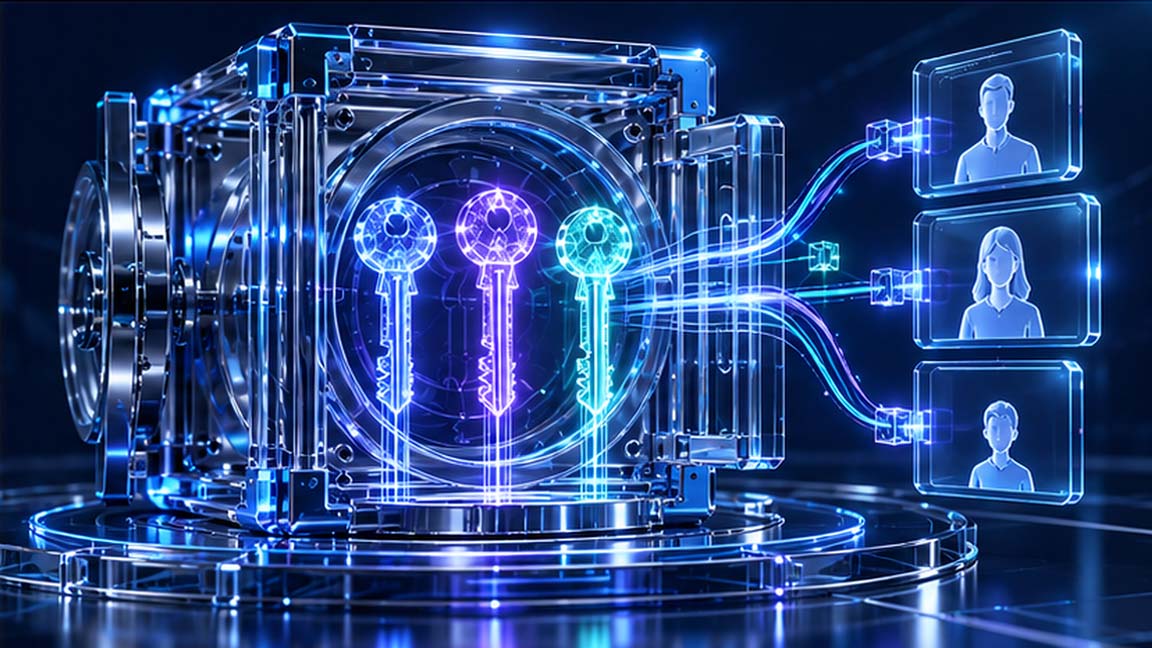
For larger amounts, more advanced solutions may make sense, such as a multi-signature wallet, known as multisig. It can require the approval of several keys to carry out a transaction. A properly designed solution thus reduces dependence on a single person or a single device. On its own, however, it is no substitute for legal documents, careful testing and a clear recovery procedure.
Clarity is also important. A technically perfect solution can fail if the heirs do not understand it. Access instructions should therefore be verifiable and workable even for someone who is not a blockchain expert.
Could smart contracts one day handle inheritance
Blockchain also opens up the possibility of automated rules. Some systems may allow multiple authorised signatures, time locks or mechanisms that enable access to be recovered under predetermined conditions. At first glance, it might seem enough to create a smart contract that sends the owner's cryptocurrencies to the heirs after their death.
The reality is more complicated. A blockchain cannot reliably determine on its own whether a person has died. It would have to rely on some external source of information or a predetermined mechanism. That could be wrong, could be misused or could fail. Moreover, an automatic transfer may not reflect the rights of all entitled heirs and the rules of the applicable inheritance law.
The greatest future benefit therefore may not lie in completely eliminating notaries or courts. A more likely outcome is linking the legal process with more secure methods of managing digital keys. Technology can make it easier to carry out an authorised transfer, but it does not by itself determine who has the right to inherit.
Conclusion
Cryptocurrencies are changing the way we can own and transfer value. Bitcoin makes it possible to hold assets without a bank, a broker or a central custodian. Yet this very feature is also one of its greatest risks when it comes to inheritance.
When we inherit traditional shares, we can prove our legal claim to the relevant institution. When we inherit Bitcoin in a self-custody wallet, the same legal claim may be of no use to us if we cannot gain access to the keys. The real responsibility of a cryptocurrency owner therefore does not end with buying and storing them securely. It also includes a well-thought-out handover to the next generations.
The future of digital inheritance may bring simpler wallets, better options for recovering access and services that connect blockchain with the traditional legal system. But the basic question will remain the same: it is not enough to know what we own. We must also make sure that the people we want to leave our assets to will one day actually be able to take them over.
This text is for informational and educational purposes only and does not constitute investment, legal or tax advice. Crypto-assets are volatile and you may lose the entire amount invested.
Author
Tomáš Bára


Cybersecurity in the World of Cryptocurrencies
An attacker does not need to break the blockchain or steal your key. It is enough to persuade you to send or sign something yourself. How do you protect your accounts, backups and transactions?

Major Players and Cryptocurrency Prices: When Is It Normal Trading and When Is It Market Manipulation?
A large bitcoin transfer to an exchange is not yet a sale, and a sharp price move is not yet manipulation. How can you tell ordinary trading from deceptive practices?