
What Is DCA and How Do Recurring Cryptocurrency Purchases Work?
The cryptocurrency market is known for significant price fluctuations. The price of Bitcoin and other cryptocurrencies can rise sharply within a short period, but it can also fall. This makes it difficult for many people to decide when the right time to buy is.
Should you buy now or wait a little longer? What if the price falls immediately after the purchase? And what if it starts rising rapidly instead and the opportunity disappears?
One approach designed to reduce dependence on a single purchase point is the DCA strategy, or Dollar-Cost Averaging. It is based on recurring purchases for a predetermined amount, regardless of the asset's current price.
DCA does not guarantee a profit or protect against a market decline. However, it can help spread purchases over a longer period, establish a regular habit and reduce emotional decision-making.
This article explains what DCA means, how it works when buying Bitcoin and other cryptocurrencies, its benefits and limitations, and what to consider before setting up a recurring purchase plan.
What Is DCA?
DCA stands for Dollar-Cost Averaging. The approach is commonly described as averaging the purchase price or investing regularly.
The principle is simple: instead of making a one-off purchase for a larger amount, an investor buys the selected asset gradually, at predetermined intervals and usually for the same amount each time.
For example, an investor may decide to buy:
Bitcoin for CZK 2,000 every month.
The purchase is made according to a predetermined plan, regardless of whether the cryptocurrency's price is rising or falling at the time.
When the price is lower, the same amount buys more cryptocurrency. When the price is higher, it buys less. The individual purchase prices are therefore averaged over time.
Although the name contains the word "Dollar", the strategy is not limited to US dollars. The same principle can be used for recurring purchases of any asset.
How Does DCA Work?
With a one-off purchase, the outcome depends heavily on the price at a specific point in time. If an investor buys just before a decline, the value of the investment may fall significantly in the short term.
DCA divides the total amount into several smaller purchases. As a result, the entire investment does not depend on a single entry point.
A simplified process may look as follows:
1. Select one or more cryptocurrencies.
2. Set the amount you want to use regularly.
3. Choose the purchase frequency.
4. Purchases are made according to the established plan.
5. Over time, you buy at different market prices.
The aim is not to find the absolute lowest price. Such a point can usually only be identified reliably in hindsight. The purpose of DCA is to create a predictable and sustainable long-term system.
Illustrative Example of Recurring Bitcoin Purchases
The DCA principle can be illustrated using a model example of purchasing Bitcoin for CZK 2,500 every week from 1 January 2020 to 3 June 2026.
Over this period, a total of 336 recurring purchases would have been made, with total contributions reaching CZK 840,000. According to the model calculation, the Bitcoin purchased would have been worth approximately CZK 1,961,000 on 3 June 2026. The difference between the amount contributed and the portfolio value would therefore have been approximately CZK 1,121,000, representing an increase of around 133.4%.
The effective average purchase price over this period would have been approximately USD 28,700 per Bitcoin.
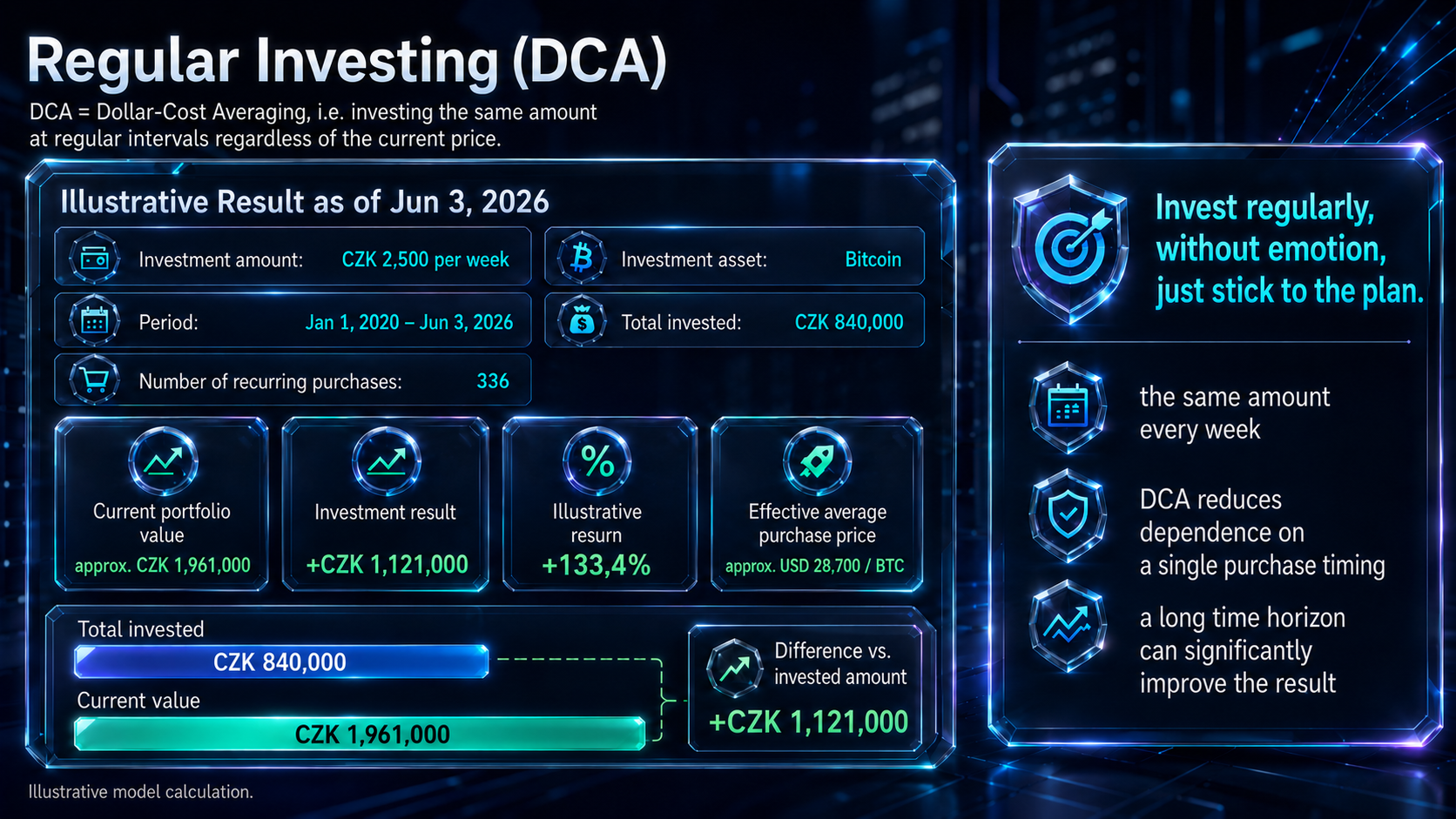
* The amounts shown in the chart are in Czech koruna (CZK). For reference, the exchange rate is 1 EUR = 24.20 CZK.
This example shows how recurring purchases spread market entry across different price periods. Over more than six years, purchases would have taken place both during periods of strong growth and during deeper price declines.
The model calculation is based on the historical price performance of Bitcoin from 1 January 2020 to 3 June 2026. It does not take fees, taxes or other related costs into account. The result varies depending on the selected period, purchase frequency, exchange rate used and the development of the Bitcoin price. Past performance is not a guarantee of future results.
Why Is DCA Used for Bitcoin and Cryptocurrencies?
DCA can be applied to different types of assets. With cryptocurrencies, this approach is often discussed mainly because of their high volatility.
The price of Bitcoin and other cryptocurrencies can rise or fall significantly over a short period. Accurately identifying the lowest point of the market is extremely difficult, even for experienced investors. Recurring purchases therefore do not attempt to predict every price movement, but follow a predetermined plan and a longer time horizon.
Before setting up DCA, it is important to understand the asset being purchased, how it works and the associated risks.
DCA Versus a One-Off Purchase
With a one-off purchase, the investor uses the entire planned amount at once.
One advantage is that the full amount of capital is immediately exposed to any potential price growth. If the price rises consistently after the purchase, a one-off purchase may produce a better result than investing gradually.
The disadvantage is the high dependence on a single point in time. If a significant decline follows the purchase, the entire amount invested loses value at the same time.
Recurring Purchases Using DCA
With DCA, the capital is divided into several smaller purchases.
The advantage is less dependence on a single entry point. Some purchases are made at a higher price and others at a lower price.
The disadvantage is that if the price rises consistently over the long term, later purchases will be made at progressively higher prices. In addition, some of the money remains uninvested for a period of time.
It is therefore not possible to say in general that one of these options is always better. The outcome depends on future market developments, which cannot be predicted with certainty.
Main Benefits of DCA
1. Less Dependence on Market Timing
DCA reduces the need to find one "perfect" moment to buy. Purchases are made during different phases of the market and at different prices.
This does not mean that timing becomes completely irrelevant. However, the impact of one poorly timed purchase is spread across several transactions.
2. Simplicity
The strategy does not require constant monitoring of price charts or complex technical analysis.
The investor determines: what to buy, what amount to use, how often to buy, and how long to continue with the plan.
3. Reduced Emotional Decision-Making
Significant market movements can lead to impulsive behaviour.
Rapid growth can trigger FOMO, or the fear of missing out. The investor may then buy simply because prices are rising and other people are buying.
During a decline, fear and panic may arise instead. The investor may end the plan at precisely the time when purchases are being made at lower prices.
DCA sets the rules in advance and can help reduce decisions based on short-term emotions.
4. Establishing a Regular Habit
Recurring purchases can help build discipline. As with other long-term financial plans, the investor does not have to decide again every month whether and when to make a purchase.
However, the chosen amount must be sustainable over the long term and must not put everyday expenses or financial reserves at risk.
Disadvantages and Limitations of DCA
DCA is not a risk-free strategy and should not be presented as an automatic route to profit.
1. It Does Not Protect Against Losses
If the price of a cryptocurrency declines over the long term, the value of positions built through recurring purchases will also fall.
A lower average purchase price will not help on its own if the value of the asset does not recover in the future.
DCA can spread purchases over time, but it does not eliminate market risk.
2. It May Produce a Lower Result in a Rising Market
If the price rises consistently from the outset, a one-off purchase made at the beginning may be more advantageous.
With DCA, additional portions of the capital are invested gradually at progressively higher prices.
3. More Transactions May Mean Higher Fees
Recurring purchases generate a larger number of individual transactions. It is therefore important to consider trading fees, any payment method fees and the terms of the specific service.
For very small amounts, fees may represent a significant proportion of the purchase.
4. The Strategy Requires Patience
DCA is generally associated with a longer time horizon. The portfolio value may remain below the total amount contributed for months or even longer.
The investor must be prepared for significant price fluctuations and should not use money that may be needed in the near future.
5. Not Every Cryptocurrency Is Viable in the Long Term
Bitcoin and some more established cryptocurrencies have a longer history and generally higher liquidity than smaller cryptocurrency projects. However, even these assets may experience a significant decline in value.
Some projects may lose most of their value, cease development or disappear altogether. Recurring purchases of such an asset only increase overall exposure to an unsuccessful project.
Before setting up DCA, it is therefore important to understand what the cryptocurrency represents, how it works and the risks associated with it.
How to Set Up a DCA Plan
Before starting recurring purchases, it is useful to answer several basic questions.
1. What Do I Want to Buy Regularly?
First, select a specific cryptocurrency or several cryptocurrencies.
The decision should not be based solely on current popularity or rapid price growth. It is important to understand the project's basic operation, use cases, risks, liquidity and history.
2. How Much Can I Afford?
The chosen amount should not put everyday living expenses, financial reserves or the ability to meet financial obligations at risk.
Cryptocurrencies are risky assets and their prices can fall significantly. Only an amount whose potential loss the investor can accept should therefore be used.
3. How Often Do I Want to Buy?
Depending on the options offered by the specific service, purchases may be made weekly, every two weeks or monthly, for example.
A shorter interval means more purchase points, but also a higher number of transactions. A longer interval is simpler, but the purchase price is spread across fewer points in time.
4. How Long Do I Want to Follow the Plan?
DCA should not be set up without any objective or rules.
It is advisable to determine in advance: the expected time horizon, the maximum total amount, the conditions for modifying the plan, and the situations in which the plan will be paused or terminated.
5. What Are the Fees?
All related costs should be reviewed before activation.
These include in particular: the purchase fee, the difference between the purchase price and the market price, any payment method fee, and any fee for transferring the cryptocurrency.
Fee policies can vary significantly between providers. Some companies clearly and transparently disclose all costs before a purchase is confirmed. With others, individual fees may be divided across several sections of the price list or included in the exchange rate used, making their true amount difficult to determine.
Before starting recurring purchases, it is therefore important to check not only the fee itself, but also how it is calculated, the exchange rate used and any additional costs. Users should know in advance the conditions under which they are using the service and what proportion of their contributed funds will actually be used to purchase cryptocurrency.
Common Mistakes When Using DCA
Selecting an Asset Without Conducting Your Own Analysis
Recurring purchases do not remove the need to understand what is being purchased. DCA is not a substitute for a basic analysis of the project.
Setting the Amount Too High
The plan must remain sustainable during periods of decline. If the amount is too high, the investor may be forced to end the strategy or sell at an unfavourable time.
Ignoring Fees
Frequent small purchases may be inefficient if a large proportion of each transaction is absorbed by fees.
Assuming That DCA Automatically Generates a Profit
DCA only determines the method and timing of purchases. The future outcome still depends primarily on the price development of the asset being purchased.
Recurring Cryptocurrency Purchases with crypto4me
crypto4me offers the Recurring Payments service, which allows users to set up recurring purchases of Bitcoin or other supported cryptocurrencies.
Users choose the amount, purchase frequency, one or more supported cryptocurrencies and the funding method. If they select multiple cryptocurrencies, they can also determine how the chosen amount will be divided among the individual assets.
Before confirming the plan, users can see an overview of the selected cryptocurrencies, the amount, fees and the date of the next purchase. An active plan can then be modified, paused or cancelled.
crypto4me does not charge a recurring monthly fee for the service. A fee is charged only when a purchase is successfully completed, and its amount is governed by the current price list.

Find out more about the service and how it works on the Recurring Payments (DCA) with crypto4me page.
Conclusion
DCA is a simple way to spread purchases of Bitcoin and other cryptocurrencies over a longer period. Instead of trying to identify a single ideal moment, the investor buys regularly for a predetermined amount.
This approach can reduce dependence on market timing, simplify the overall process and help limit the influence of emotions on decision-making.
However, DCA does not guarantee a profit, protect against a price decline or always produce a better result than a one-off purchase. The outcome depends on the performance of the selected asset, the length of the investment horizon, the level of fees and the ability to follow the predetermined plan.
A responsible approach therefore still requires an understanding of the asset being purchased, a realistic assessment of one's financial circumstances and awareness that the value of cryptocurrencies can rise or fall significantly.
Author
Tomáš Bára


Stablecoins: Digital Money Between Crypto and Traditional Finance
Bitcoin and Ethereum showed just how volatile the world of cryptocurrencies can be. That's exactly why one of the most important parts of this market became stablecoins – assets whose goal is to not change their value. Find out what keeps their price stable, how USDC, USDT, or crypto-collateralized tokens differ, and what the collapse of TerraUSD revealed.

Layer 1 and Layer 2: Why Blockchain Needs More Layers
Bitcoin and Ethereum showed that blockchain can work without a central authority. But as the number of users grew, capacity limits and rising fees followed. Find out how Layer 1 forms a secure foundation and how Layer 2 solutions like Lightning Network or rollups help it handle more traffic.