
Layer 1 and Layer 2: Why Blockchain Needs More Layers
Bitcoin and Ethereum showed that it is possible to transfer digital value and run financial applications without a single central authority. But as the number of users grew, another question emerged: how can a blockchain serve millions of people without slowing down, becoming significantly more expensive, or losing its security and decentralization?
Blockchain capacity is not unlimited. If too many people try to use the network at once, individual transactions start competing for limited space in blocks and fees can rise.
This is exactly the problem that splitting blockchain infrastructure into Layer 1 and Layer 2 helps solve.
What is Layer 1
Layer 1 is the base blockchain itself, the foundation the whole system is built on. Bitcoin, Ethereum, and Solana, for example, are separate Layer 1 networks because each has its own rules, its own way of verifying transactions, and its own consensus mechanism.
The job of Layer 1 is to make sure the network agrees on which transactions are valid, in what order they happened, and what the current state of the blockchain looks like. Bitcoin uses Proof of Work for this, while Ethereum runs on Proof of Stake.
Layer 1 is therefore primarily the security and settlement foundation of the entire network.
Why we cannot simply speed up Layer 1
At first glance, it might seem enough to boost the network's performance or make blocks bigger.
But a blockchain is not an ordinary database run by a single company. Its whole point is that a large number of participants can verify it independently.
If we raise the hardware or data requirements too much, the network may indeed become faster, but it can also become more centralized.
Blockchain therefore has to balance three properties: security, decentralization, and scalability. This problem is often called the blockchain trilemma.
One way to scale without seriously weakening the base layer is exactly what Layer 2 solutions do.
What is Layer 2
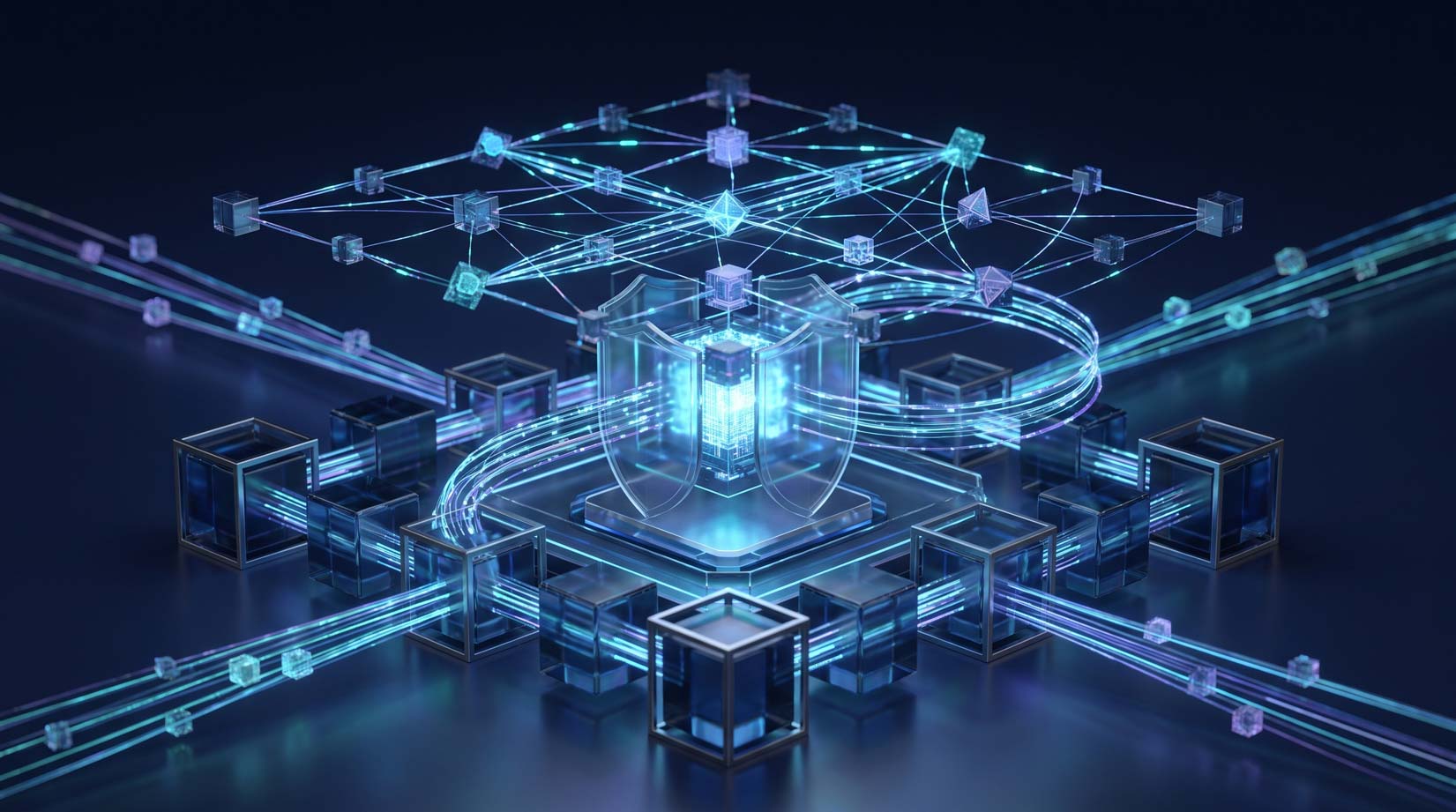
Layer 2 is technology built on top of the main blockchain that takes over part of its workload.
Instead of Layer 1 processing every single operation, Layer 2 can handle a larger volume of transactions more efficiently and then use the main blockchain for their final settlement or verification.
In simple terms:
Layer 1 provides a secure foundation, Layer 2 helps use that foundation faster and more cheaply.

Bitcoin and the Lightning Network
Bitcoin illustrates well why additional layers make sense. Its base network is designed very conservatively, and a new block is created on average roughly once every ten minutes. This helps security and decentralization, but it is not ideal for a huge volume of small everyday payments.
One solution is the Lightning Network.
Its main principle is that not every single bitcoin payment has to be written to the main blockchain immediately.
Users can open what is called a payment channel, in which they repeatedly transfer value between each other. Only the final state is then settled on Bitcoin.
The principle can be compared to an open tab at a restaurant. During the evening, you do not have to pay for every order separately. Individual items are recorded along the way, and the final amount is settled at the end.
Individual Lightning channels are also connected into a whole network. So a user does not need a direct channel with every single person they want to pay.
The result can be fast bitcoin payments with low fees, without each one immediately burdening the main Bitcoin blockchain.
Ethereum and rollups
Ethereum deals with a similar problem, but its network is used in a much broader way.
The Ethereum Mainnet is not just used for ETH transfers. It also runs decentralized exchanges, stablecoins, lending protocols, NFTs, and entire smart contract applications.
When the network is busier, the price of transaction space rises, and with it the fees, known as gas.
That is why Ethereum increasingly relies on Layer 2 solutions called rollups.
A rollup processes a larger number of transactions outside the main Ethereum chain, bundles them together, and sends only the necessary data, result, or cryptographic proof to the Mainnet.
This allows a large volume of transactions to be processed faster and more cheaply, while Ethereum remains the security and settlement foundation. Well-known Ethereum Layer 2 networks include Arbitrum, Optimism, and Base.
Optimistic and ZK-rollups
Rollups mainly split into two main approaches. Optimistic rollups assume the result of transactions is correct unless someone proves otherwise. ZK-rollups, on the other hand, produce a cryptographic proof alongside the result that confirms the computation is correct.
In simple terms: an optimistic rollup says "let's treat the result as correct unless someone proves otherwise," while a ZK-rollup says "here is the result, and here is proof that it is correct." Neither approach is automatically better, each has its own advantages and technical trade-offs.
Layer 2 is not automatically as secure as Layer 1
It is also important to know that the label Layer 2 alone is not a guarantee of the same level of security as the main blockchain.
A specific solution may, for example, have more centralized elements, a bug in a smart contract, or risks when moving funds between networks.
Likewise, not every fast network connected to Ethereum is automatically a Layer 2. For example, a sidechain is a separate blockchain with its own validators and its own security model.
So it makes sense to ask a simple question:
Where does this particular network actually get its security from?
What this means for the average user
The difference between the individual layers may not be very visible when using a wallet.
Still, it is important to know which network your funds actually sit on.
For example, ETH on the Ethereum Mainnet and ETH on a Layer 2 may have the same economic value, but technically they are on different networks. Likewise, not every exchange supports every Layer 2.
When transferring crypto, it is therefore not enough to check only the recipient's address. You need to verify the correct network, whether the exchange or wallet supports it, the current fees, and possibly the transfer method via a bridge. At the same time, Layer 2 does not automatically mean the same level of security as Layer 1.
Conclusion
Layer 1 forms the secure foundation of the blockchain. It provides consensus, transaction history, and final settlement. But its capacity is not unlimited, and it is not always efficient for processing every small operation.
Layer 2 therefore allows part of the workload to move on top of the base blockchain. Bitcoin uses, for example, the Lightning Network for fast payments, while Ethereum uses rollups for transactions, smart contracts, and entire decentralized applications.
The future of blockchain will therefore likely not rest on a single network that has to handle absolutely everything. Instead, it will more likely be a multi-layer infrastructure, where Layer 1 provides a secure foundation and additional layers on top of it bring higher speed, lower costs, and room for everyday use.
This text is for informational and educational purposes only and does not constitute investment advice. Crypto assets are volatile and you may lose the entire invested amount.
Author
Tomáš Bára


Stablecoins: Digital Money Between Crypto and Traditional Finance
Bitcoin and Ethereum showed just how volatile the world of cryptocurrencies can be. That's exactly why one of the most important parts of this market became stablecoins – assets whose goal is to not change their value. Find out what keeps their price stable, how USDC, USDT, or crypto-collateralized tokens differ, and what the collapse of TerraUSD revealed.

Layer 1 and Layer 2: Why Blockchain Needs More Layers
Bitcoin and Ethereum showed that blockchain can work without a central authority. But as the number of users grew, capacity limits and rising fees followed. Find out how Layer 1 forms a secure foundation and how Layer 2 solutions like Lightning Network or rollups help it handle more traffic.