
Bitcoin-Backed Mortgages: The Evolution of Financing or the Beginning of a Revolution?
You own Bitcoin whose value has risen significantly over several years. You want to buy a property, but you do not want to sell your cryptocurrency. Can Bitcoin become collateral that gets you the financing you need? In the United States, such a model already works. Alongside new opportunities, however, it also brings risks that differ significantly from those of a regular mortgage.
Imagine an investor who has been buying Bitcoin regularly for several years and has gradually built a portfolio worth several million Czech crowns. Now they want to buy a home of their own. Although they own valuable assets, they do not have enough available cash to pay for the entire property or even the required down payment.
The simplest solution would be to sell part of the Bitcoin. The investor would convert the proceeds into a regular currency and use them to buy the property. However, they would lose part of their investment and with it the chance to share in any future appreciation.
But there is another way. They can use Bitcoin as collateral for a loan, obtain the funds they need and, under certain conditions, keep their original investment position.
At first glance, this is just another way of securing a loan. This approach, however, opens a broader question: Can Bitcoin, in addition to being an investment asset, gradually also take on the role of an asset against which financial institutions will routinely lend?
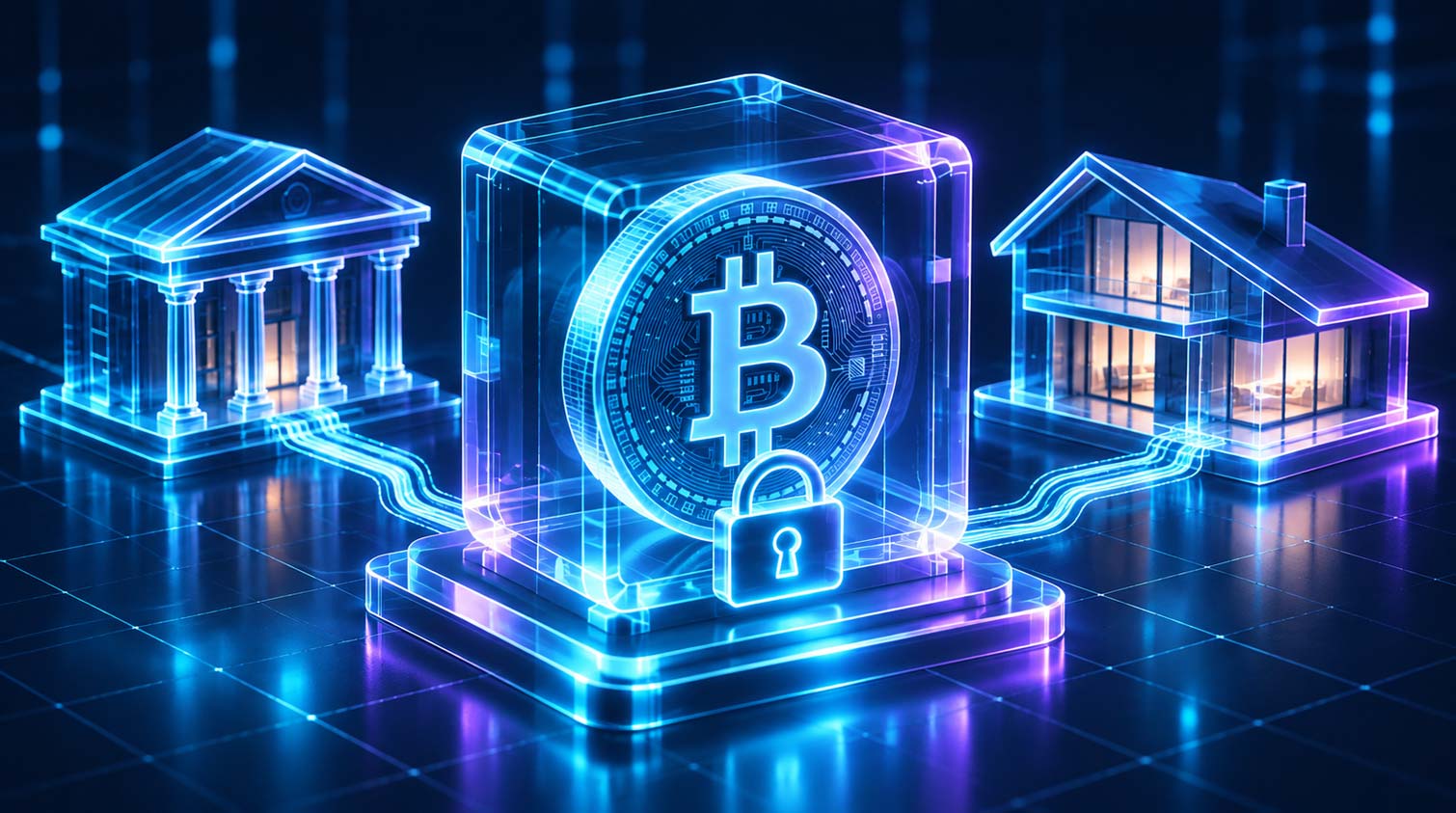
Bitcoin as collateral: a principle that is not new in finance
Loans secured by valuable assets are nothing new in the financial world.
With a classic mortgage, the bank usually uses the property being purchased as security for the loan. In other forms of financing, investment portfolios or securities, for example, can serve as collateral.
Bitcoin-backed loans are based on the same principle. The client does not have to sell the asset. They pledge it as collateral, against which they receive a loan in a regular currency.
The fundamental difference lies in the nature of the pledged asset.
Real estate has a physical form, registered ownership, and its price usually changes more slowly. Bitcoin, by contrast, is a digital asset traded around the clock on a global market. Its value can rise, but also fall by tens of percent within a short time.
This significantly affects the terms of financing. The lender must determine how large a loan it will provide against Bitcoin, who will control the cryptocurrency during repayment and under what conditions the collateral can be sold.
At the same time, it must decide whether the client will be required to add more Bitcoin if the price falls, or whether price fluctuations will not be directly reflected in the course of repayment.
It is precisely the different approaches to these questions that have led to the emergence of several models of Bitcoin financing.
A Bitcoin mortgage does not take a single form
The term "Bitcoin mortgage" can be misleading. It does not necessarily mean a classic mortgage loan for which the client pledges only Bitcoin instead of real estate.
In practice, we mainly encounter three approaches.
The first option is a Bitcoin-backed loan. The investor pledges cryptocurrency and, depending on the contractual terms, can use the money obtained, for example, to buy or renovate a property or for other expenses. Such a loan, however, need not be a mortgage in the usual legal sense.
The second model combines a classic mortgage with a Bitcoin loan. The client obtains a standard mortgage on the property, while Bitcoin secures an additional loan intended to finance the down payment.
The third approach uses Bitcoin when assessing the client's financial background. The cryptocurrency does not have to be pledged directly. The provider can count it among the applicant's financial reserves, which document their financial situation.
There are fundamental differences between these models. In some cases, the client risks a forced sale of Bitcoin if the price drops; in others, the collateral remains locked for a long time. Yet another model allows them to keep the cryptocurrency in their own wallet.
We will illustrate the differences using specific products that already exist on the market.
Coinbase and Better Mortgage: Bitcoin helps finance the down payment
One example is the partnership between the American cryptocurrency company Coinbase and the mortgage provider Better Mortgage.
In March 2026, the two companies introduced a product that allows Bitcoin to be used as collateral to finance the down payment when buying a property. In June, they announced the first such mortgage, and on 26 August 2026 they made the product available to a wider range of eligible American clients.
So it did not remain just a technological concept. Real buyers have already used this method of financing.
The model combines two loans.
The first is a standard mortgage secured by the property being purchased. The second loan finances the buyer's down payment and is secured by Bitcoin. In addition, a further lien on the property serves to secure it.
Both loans are arranged and serviced by Better Mortgage. The client pays a single combined monthly payment. Coinbase provides the related technology services and infrastructure for the custody of the cryptocurrency, not the mortgage itself.
How does the financing work in practice?
Imagine a buyer who wants to purchase a property for 500,000 US dollars.
They obtain a classic mortgage for 400,000 dollars. The remaining 100,000 dollars, which they would otherwise have to contribute from their own funds, they borrow against Bitcoin.
The initial value of the pledged Bitcoin must be at least 250% of the second loan amount.
For a loan of 100,000 dollars, they therefore need Bitcoin worth at least 250,000 dollars.
The buyer does not have to sell the pledged Bitcoin, and any future appreciation may continue to belong to them economically. However, they must repay both loans and cannot freely dispose of the cryptocurrency for as long as it is pledged.
Moreover, owning Bitcoin does not replace the standard creditworthiness assessment. To obtain the main mortgage, the client must still meet the usual requirements for income, credit history and debt-to-income ratio.
In this product, Bitcoin therefore mainly helps with financing the down payment. On its own, it will not secure a mortgage for a client without sufficient income.
A mortgage without a margin call? Yes, but not without risk
A distinctive feature of the Better Mortgage and Coinbase product is its approach to a possible decline in the price of Bitcoin.
With ordinary crypto loans, a sharp fall in the value of the collateral can trigger a demand to add further funds. This mechanism is known as a margin call.
Better Mortgage, however, states that a drop in the BTC price alone does not lead to an obligation to top up the collateral or to its automatic liquidation.
If a client pledges Bitcoin worth 250,000 dollars and its price subsequently falls by half, this drop alone does not automatically trigger a sale of the cryptocurrency.
The condition remains proper repayment of the loan.
In the event of default, the situation changes. According to the published terms, Better may proceed to liquidate the necessary part of the Bitcoin collateral after 60 days of missed payments.
This model thus limits one of the main risks of ordinary crypto loans. However, it does not protect the client from losing the pledged assets if they fail to repay.
This is not a rule that applies to all Bitcoin mortgages. Other providers may use different collateral and liquidation mechanisms.
I keep my Bitcoin. But who actually controls it?
The ability to keep the investment is one of the main arguments for Bitcoin financing. However, it is necessary to distinguish between ownership of an asset, an economic claim to it and actual control over it.
As long as the investor holds Bitcoin in their own wallet and controls the private keys, they alone can decide on its transfer.
Once they use it as collateral, however, the situation may change fundamentally.
With the Better Mortgage and Coinbase product, the client transfers the pledged Bitcoin to an account controlled by the lender within the Coinbase Prime infrastructure.
In September 2026, CoinDesk pointed out an important aspect of the loan terms.
Better Mortgage allows so-called rehypothecation. The lender may thus reuse the pledged Bitcoin in other financial transactions, provided it retains the corresponding amount of BTC needed for its future return.
The client therefore may not have the very same coins they originally provided reserved for them throughout the entire loan. According to the contractual terms, they are instead to receive back an equivalent amount of Bitcoin.
This creates an additional risk that does not depend solely on the price of Bitcoin: whether the provider is able to meet its obligation.
If the lender or one of the financial entities involved ran into serious trouble, it would also matter how the client's rights to the pledged assets are protected legally and technically.
Another limitation is the length of time the collateral remains locked. According to information from Better Mortgage and Coinbase documentation, the Bitcoin is released only after the main mortgage has been fully repaid or refinanced.
Repaying the down payment loan alone may therefore not be enough to release the Bitcoin.
With a mortgage arranged for 30 years, for example, this can be an exceptionally long period.
This clearly illustrates the difference between holding Bitcoin and using it as collateral for a loan.
The investor can continue to share in the growth of BTC's value, even though they do not have direct control over it for as long as it is pledged.
Milo: Crypto-backed mortgages have been around since 2022
Coinbase and Better Mortgage are not the first companies to link Bitcoin with home financing.
The American company Milo introduced a crypto-backed mortgage as early as 2022.
According to the company's figures, the total volume of crypto mortgages it had provided exceeded 100 million US dollars in 2026.
Milo, however, offers a different model from Better Mortgage.
The Crypto Mortgage product makes it possible to finance up to 100% of the purchase price of a property in the USA by providing crypto collateral whose initial value corresponds to the loan amount. Bitcoin or Ethereum can serve as collateral.
A client buying a property for 500,000 dollars can thus, under the product's terms, pledge cryptocurrencies of the same value and obtain a loan for the entire purchase price.
The loan is therefore secured by both the property and the cryptocurrency.
The repayment method also differs. For this mortgage, Milo states a fixed interest rate and interest-only payments without mandatory ongoing amortisation of the principal.
The monthly payments thus cover the interest. The client must repay the principal itself later, for example when selling the property, refinancing or by making an extraordinary payment.
A lower ongoing payment therefore does not necessarily mean cheaper financing. The client must bear in mind that paying interest alone does not reduce their debt.
They own assets, but their income may not be enough for a mortgage
Milo's founder Josip Rupena, in an interview with the American real estate news site Inman, pointed out a problem of the traditional mortgage market.
Some clients own considerable assets, but their regular income may not meet the requirements of ordinary mortgage products.
This may apply, for example, to entrepreneurs, investors or self-employed people. Their financial background may be considerably stronger than their regular income alone would suggest.
According to this approach, Bitcoin financing therefore makes it possible not only to avoid selling cryptocurrency, but also to broaden the way lenders assess clients' financial background.
Even valuable Bitcoin holdings, however, do not in themselves guarantee the ability to repay a long-term loan.
The very difference between the value of assets and the income available for repayments is one of the important questions the lender must assess.
A different approach: Bitcoin as a financial reserve
Milo also offers a product called Self-Custody Mortgage.
In it, Bitcoin can serve as part of the client's documented financial reserves without the client having to transfer it into the lender's custody.
Here, the cryptocurrency therefore does not function as directly pledged Bitcoin. The provider takes it into account when assessing the client's financial circumstances, but the client still needs their own money to finance the relevant part of the property.
This model shows that the use of cryptocurrencies in home financing need not consist solely of pledging them.
Digital assets can also gradually become a commonly recognised part of a client's financial profile.
Firefish: A European model of Bitcoin-backed loans
Examples of this type of financing can also be found in Europe.
The Firefish platform focuses on Bitcoin-backed loans. They allow the client to obtain money without selling their cryptocurrency.
Firefish is not a classic mortgage bank and does not offer the same product as Better Mortgage. However, depending on the terms, the loan obtained can be used for various purposes, possibly including financing a property.
The main difference lies in the technical solution for holding the collateral.
According to Firefish's published documentation, the Bitcoin is locked using a multisignature mechanism directly on the Bitcoin blockchain. The collateral can only be moved under predetermined conditions, for example after the loan has been fully repaid or in the event of liquidation.
This is a different solution from the case where the lender can further use the pledged cryptocurrency in its own transactions.
Firefish, however, continuously monitors the value of the collateral. The client must therefore reckon with the risk of price fluctuations.
According to the documentation, margin call notifications are linked to LTV levels of 73%, 79% and 86%. When the liquidation threshold of 95% LTV is reached, the collateral may be sold.
Each of the models thus brings different advantages and risks.
In the first case, the client does not face automatic liquidation if the price falls, but entrusts Bitcoin to a lender that can reuse it. In the second, custody is handled differently from a technical standpoint, but a sharp price drop can lead to a forced sale of the collateral.
None of these models can therefore be described as safer in every respect.
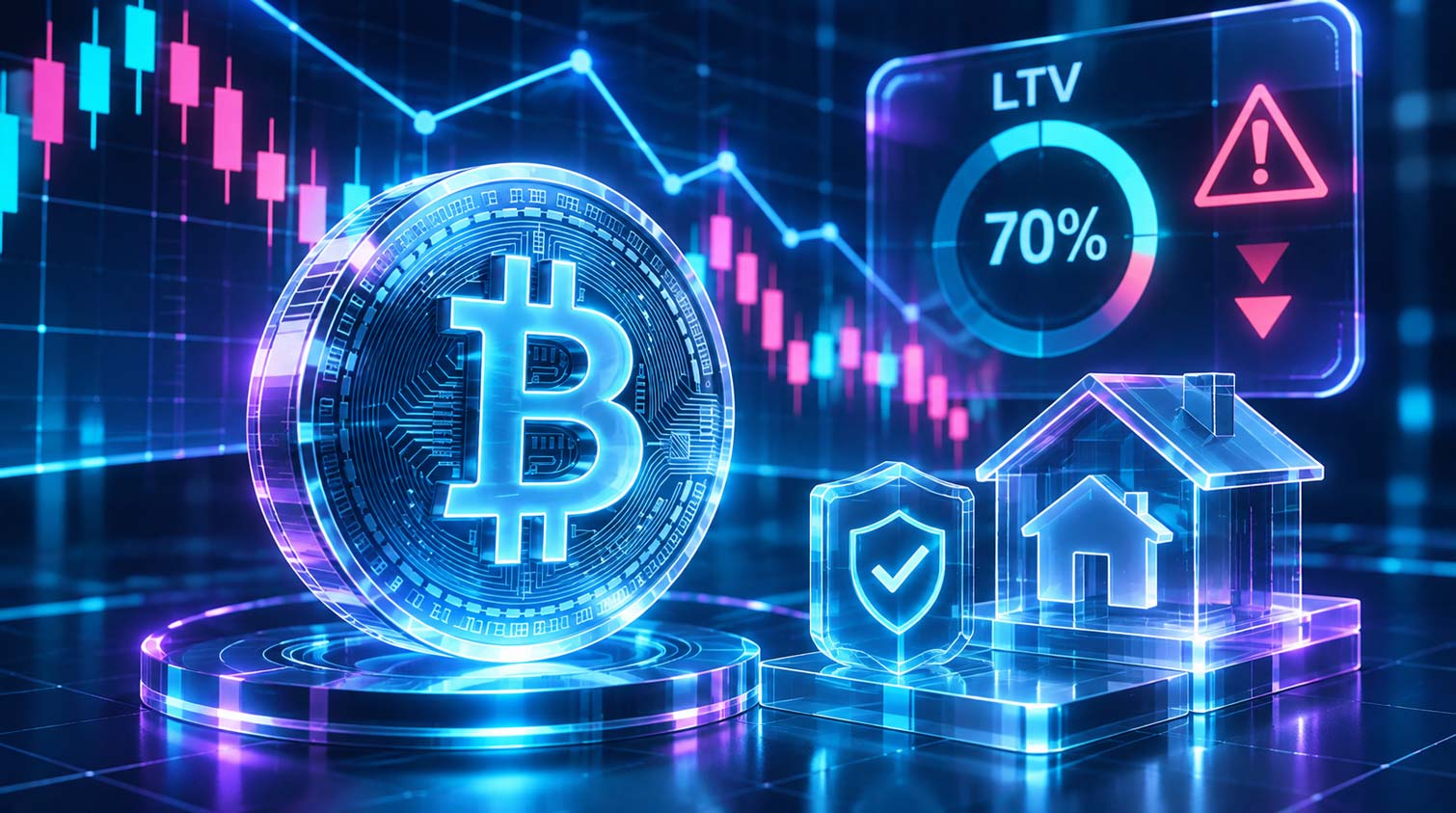
What does LTV mean and why is it so important with Bitcoin?
LTV (Loan-to-Value) refers to the ratio of the loan amount to the value of the collateral.
Imagine an investor who owns Bitcoin worth 5 million Czech crowns. They pledge it and borrow 2 million crowns against it.
The initial LTV is 40%.
If the price of Bitcoin doubles in the following years, the value of the collateral rises to 10 million crowns. With an unchanged principal, the LTV falls to 20%.
If, however, Bitcoin loses half its value, the value of the collateral falls to 2.5 million crowns and the LTV rises to 80%.
After a further drop of 20% from this new value, the pledged Bitcoin would be worth 2 million crowns. The LTV would reach 100% and the value of the collateral would equal the outstanding principal of the loan.
Such a development represents a significant risk for both lender and borrower.
With loans where the collateral is continuously revalued, the investor may receive a request to add more Bitcoin or to repay part of the debt.
If they do not comply with the request, a forced sale of the cryptocurrency may follow.
For a long-term BTC holder, such a situation is risky. They may lose their Bitcoin precisely during a market downturn, even though they originally planned to hold it for many years.
If the price of the cryptocurrency then rises again, they may no longer share in its recovery.
What matters, therefore, is not only the initial LTV, but also the specific contractual terms, how often the collateral is revalued and the threshold at which the provider can sell it.
Classic mortgage versus Bitcoin financing
A classic mortgage and financing using Bitcoin differ not only in the type of collateral.
Security
Classic mortgage: Usually real estate
Financing using BTC: Bitcoin, real estate or a combination of both
Own funds
Classic mortgage: Usually cash savings or other accepted sources
Financing using BTC: With selected products, a loan against BTC can be obtained for the down payment
Client assessment
Classic mortgage: Income, liabilities, credit history
Financing using BTC: Depending on the product, also digital assets owned
Price volatility
Classic mortgage: The value of real estate usually changes more slowly
Financing using BTC: Bitcoin can fluctuate significantly within a short time
Margin call
Classic mortgage: Not a common feature of a standard mortgage
Financing using BTC: Exists with some products, not with others
Control over the collateral
Classic mortgage: The client usually continues to use the property
Financing using BTC: The client often cannot freely dispose of the BTC
Repayment
Classic mortgage: Usually regular payments of principal and interest
Financing using BTC: Depending on the product, annuity repayment, interest-only payments or another arrangement
Availability
Classic mortgage: Established banking market
Financing using BTC: Specialised products with limited availability
From an economic point of view, the key point is the ability to use investment assets one already owns to obtain additional funds.
At the same time, however, the investor limits their financial flexibility and takes on new credit obligations.
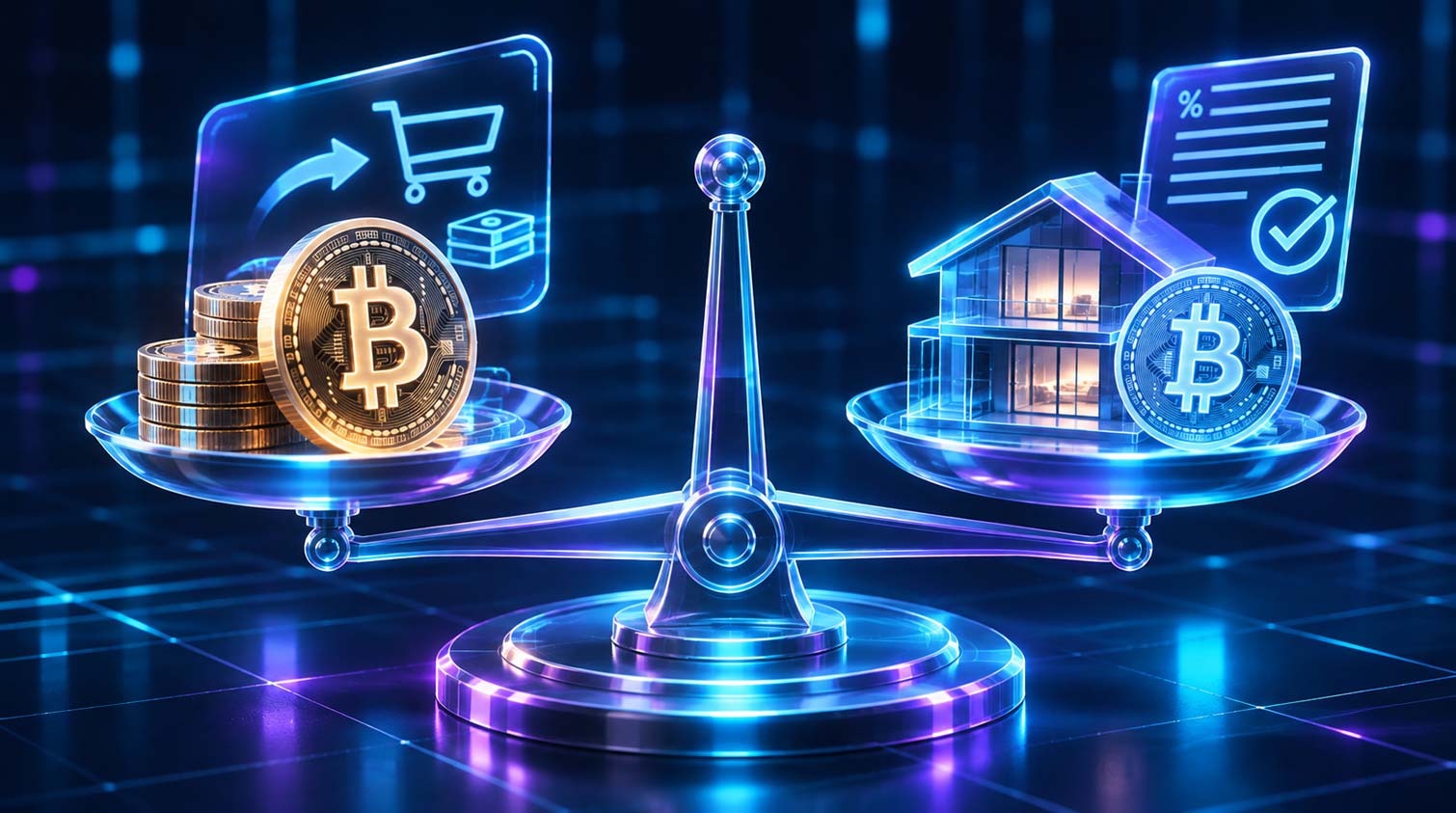
Is it worth pledging Bitcoin, or is it better to sell it?
Imagine two investors. Each owns Bitcoin worth 5 million Czech crowns and needs 2 million crowns to finance a home.
The first investor sells Bitcoin for 2 million crowns and uses the money to buy a property. They keep the rest of their BTC.
The second does not sell Bitcoin and instead borrows 2 million crowns against crypto collateral.
If the price of Bitcoin rises significantly in the following years, the second investor can benefit from the appreciation of a larger amount of BTC.
At the same time, however, they must pay interest and loan repayments from their income. Depending on the contractual terms, they also risk losing the collateral.
The first investor did sell part of their Bitcoin, but did not take on any additional credit obligation. They also no longer expose the sold part of the cryptocurrency to the risk of a forced sale due to the loan or to problems with the collateral custodian.
If, on the other hand, Bitcoin weakens significantly, the second investor's situation may become complicated. The value of their assets falls, while the amount of the debt does not automatically decrease.
The merits of the two options therefore cannot be judged solely by the expected development of the Bitcoin price.
The interest rate, the total cost of the loan, the tax implications of selling cryptocurrency, the ability to repay and the size of the financial reserve the investor has left after the transaction also play a decisive role.
A Bitcoin-backed loan can thus help preserve an investment, but at the same time it increases indebtedness.
Can a rising Bitcoin price gradually pay off a mortgage?
Bitcoin financing also raises the question of whether future growth in the price of the cryptocurrency can be used to reduce debt.
Imagine an investor who pledges Bitcoin worth 5 million Czech crowns and obtains a loan of 2 million crowns.
After a few years, the price of Bitcoin rises and the value of the pledged assets reaches 10 million crowns.
In theory, the investor could release part of the surplus collateral, sell the corresponding amount of BTC and use the proceeds for an extraordinary loan repayment.
In practice, however, it depends on whether the provider allows partial release of the collateral.
Some products require the Bitcoin to remain locked until the loan is fully repaid or refinanced. Others do not allow withdrawal of even part of the collateral whose value has risen significantly in the meantime.
It is therefore important to distinguish between growth in the value of an investment and actual reduction of debt.
A rising Bitcoin price alone does not pay off a mortgage. It can increase the value of the security or, under certain conditions, enable a further financial operation.
If the price of Bitcoin did not rise over the long term, the investor would have to continue repaying the loan under the agreed terms.
Are real customers interested in Bitcoin mortgages?
Available data suggest that this type of financing is attracting investor interest and that part of the demand has already led to loans actually being provided.
According to Milo's founder, more than 10,000 interested parties signed up to the waiting list when the crypto mortgage was launched in 2022.
By 2026, according to its own figures, Milo had provided crypto mortgages worth more than 100 million dollars.
Better Mortgage and Coinbase have also published figures on interest.
Before the product's wider market launch, they recorded potential financing totalling over 260 million dollars. In a survey among interested parties, 60% of respondents said they planned to buy a property within the following six months.
In September 2026, Better then told CoinDesk that preliminary applications had reached a total requested volume of 360 million dollars.
This does not mean, however, that all of these amounts were actually approved or disbursed.
Expressed interest, a submitted application and completed financing are three different things.
Demand is also influenced by the customer mix. The products are aimed mainly at those who already own cryptocurrencies and want to maintain a long-term investment position.
Nevertheless, it is a signal that holders of digital assets are looking for ways to use their value beyond trading on crypto exchanges.
What are the first experiences and reactions?
A specific experience of financing a home with Bitcoin was also described by the British newspaper Financial Times.
In October 2026, it presented the story of an American buyer who borrowed approximately 130,000 dollars against Bitcoin to finance the down payment on a property.
In addition to a standard mortgage, he thus obtained another loan without having to sell his Bitcoin investment.
The case illustrates the main motivation of those interested. They need not be people without assets. On the contrary, they may own considerable funds held in assets they do not want to sell.
With growing interest, however, critical questions are also emerging.
Financial media point to the risk of excessive indebtedness, the high volatility of digital assets and the client's long-term dependence on the lender.
Further reservations concern the handling of pledged Bitcoin. If the lender can reuse it, risks arise that are not apparent from the interest rate or the declared LTV alone.
A Bitcoin mortgage may thus appeal to a client with considerable digital assets and a stable income. However, it may not be suitable for everyone looking for a home.
And what about the Czech Republic?
Although European platforms make it possible to obtain a Bitcoin-backed loan, linking it directly to an ordinary Czech mortgage still faces significant obstacles.
In October 2026, the topic was covered by Investiční web, which approached representatives of Komerční banka and Partners Banka.
According to Komerční banka's mortgage manager Ondřej Šuchman, the American model, in which the client finances the down payment with another loan, would run up against the Czech National Bank's recommendations regarding the applicant's own funds.
The bank assesses not only the value of the security, but also the origin of the client's own funds and their overall ability to repay.
Another complication is the high volatility of Bitcoin.
If Bitcoin served directly as bank collateral, the financial institution would have to take its price fluctuations into account in its risk management. The loan provided could therefore be significantly lower than with real estate collateral of the same value.
According to Partners Banka spokesperson Tereza Píchalová, the use of Bitcoin in home financing was, as of October 2026, still at the consideration stage. The bank did not have a specific product ready.
The link between crypto loans and mortgages had already been discussed in the Czech Republic earlier.
In November 2025, Hospodářské noviny covered the topic in an episode of the Ranní brífink podcast with Tomáš Dzurilla of Firefish.
The debate also touched on broader developments in the financial market, including the then plans of the American bank JPMorgan to accept Bitcoin and Ethereum as loan collateral for institutional clients.
Interest in cryptocurrencies as loan collateral is therefore not limited to specialised Bitcoin companies.
Institutional loans, however, must be distinguished from household mortgages. The fact that a bank accepts cryptocurrencies as collateral when financing large clients does not mean that it will start accepting them for ordinary mortgages.
Czech applicants should therefore separately verify the availability of a BTC-backed loan and, separately, the possibility of using the money obtained in specific mortgage financing.
What should an investor check before using a Bitcoin loan?
Before deciding, it is not enough to compare just the interest rate and the maximum loan amount available.
What matters is understanding the entire structure of the loan.
The investor should know whether the Bitcoin will be locked for the duration of the loan, who will control it and whether the provider may reuse it.
Equally important are the conditions under which the collateral may be sold. With some products, the main reason is non-repayment; elsewhere, a significant drop in price can also trigger liquidation.
The repayment method also deserves attention. In the long run, there is a fundamental difference between a loan with ongoing amortisation of the principal and a product where the client regularly pays only interest.
Also important are the options for early repayment and release of surplus collateral, the client's legal protection in the event of the provider's insolvency, and any currency and tax implications.
The client must also consider what they will use to repay the loan. If they need their regular income to run the household, they should not rely on a future rise in the price of Bitcoin to settle their obligations.
Financing a home is a long-term decision. Its safety cannot be built solely on the expectation that a risky asset will grow.
Revolution or evolution of the financial system?
Current developments offer two perspectives.
From a technological point of view, Bitcoin-backed loans are not a complete revolution. Lending against valuable assets is a long-established financial principle.
What is new is the use of a digital asset that has a global market, specific methods of custody and markedly different price dynamics.
For long-term Bitcoin holders, however, this can be a significant change.
Bitcoin no longer has to be just an investment that can be held or sold. It can also serve as an asset whose value helps finance other life decisions.
The broader question of how assets are assessed is also important.
Traditional mortgages rely to a large extent on regular income, credit history and established forms of security. Some owners of digital assets, however, may have considerable investment assets even though their financial profile does not fit typical banking models.
If financial institutions learn to safely value, manage and accept digital assets as part of financing, this could gradually change the way loans are provided.
At the same time, however, wider availability of loans against Bitcoin may increase investors' indebtedness and deepen their dependence on the development of the cryptocurrency's price.
The spread of Bitcoin mortgages therefore need not, in itself, mean progress.
What will matter most is the transparency of contractual terms, the legal protection of clients, the security of the collateral and the system's ability to hold up even during significant market downturns.
Conclusion
Bitcoin-backed mortgages and loans are no longer just a theoretical concept. In the United States, there are products that allow digital assets to be used in financing real estate.
Milo, Better Mortgage and Coinbase show that Bitcoin can gradually take on a further financial function alongside investing and trading.
The individual products, however, differ fundamentally. In some cases, Bitcoin directly secures the mortgage; in others, it serves as collateral for a down payment loan. In yet other cases, the provider takes it into account as part of the client's financial reserves.
It is precisely these differences that determine what rights the investor retains and what risks they face.
For some, a Bitcoin-backed loan may be a way to finance a home without selling a long-term investment. For others, it may be more advantageous to sell part of their cryptocurrency and not take on additional debt.
From today's perspective, Bitcoin mortgages therefore represent an evolution rather than an immediate revolution of the financial system.
Their long-term significance, however, may be broader.
It is not just about the possibility of buying a property without selling Bitcoin. It is also about a gradual change in the financial world's approach to digital assets and their use in the real economy.
Sources used
1. Hospodářské noviny – Bude možné ručit bitcoinem za hypotéku? (5. 11. 2025)
2. CoinDesk – Better and Coinbase’s bitcoin-backed mortgages can reuse borrowers’ collateral (6. 9. 2026)
3. Financial Times – Would you take out a mortgage backed by bitcoin? (22. 10. 2026)
4. Investiční web – Bitcoin jako akontace pro vlastní bydlení (2. 10. 2026)
5. Inman – Why crypto-backed mortgages aren't quite mainstream yet (13. 4. 2026)
6. Coinbase – Official documentation on crypto mortgages
7. Milo – Official information on mortgage products
8. Firefish – Collateral and liquidation documentation
The information reflects the state of available sources as of November 2026. This text is for educational purposes and does not constitute individual investment, credit, legal or tax advice.
Author
Tomáš Bára

Cryptocurrency Scams

Staking: Where Do the Rewards Come From?
Staking lets you earn rewards for helping secure a blockchain network. Find out where the rewards actually come from, how to read APR and APY, what liquid staking adds, and which risks and withdrawal conditions are worth knowing in advance.