Why Retail Investors Buy Altcoins: Technology, Psychology and Outside Advice
Crypto4me has looked at how its retail clients approach altcoins. The study compares the platform's practical experience with available research on two questions: what technically sets the major altcoins – Ethereum, Solana, Cardano and XRP – apart from Bitcoin, and what actually motivates retail investors to buy cryptocurrencies other than Bitcoin.
Beyond Bitcoin: The Rational Case and the Real One
Bitcoin has established itself as digital gold: a decentralized store of value. Yet both retail and institutional investors increasingly buy other cryptocurrencies as well, commonly called altcoins. There is a reason for this. Bitcoin was deliberately designed above all to be secure and hard to change, and that comes at a price: it can process only a limited number of transactions and cannot easily run more complex applications. Other blockchain networks have grown up to fill these gaps, each specializing in something different.
Seen from this angle, buying altcoins can be a rational way to spread money across networks that do different jobs. Ethereum, Solana, Cardano and XRP are not copies of Bitcoin; each was built to solve a different problem. But this is how an analyst sees it. Judging how a blockchain reaches agreement, how it handles growing traffic or how quickly a payment becomes final requires technical knowledge that most retail investors do not have – and should not need to have. In practice, many altcoin purchases are therefore driven less by technology and more by psychology, simple rules of thumb and the advice of brokers, advisers, media and influencers.
This study first summarizes what really distinguishes four of the best-known altcoins, and then looks at how retail investors actually decide to buy them. The behavioural shortcuts and outside influences that often replace analysis are drawn not only from research papers, but also from crypto4me's practical experience with the behaviour of sample of its clients participating in educational activities of crypto4me. These client observations are illustrative and should not be taken as representative of retail investors generally.
Part One: What the Technology Says
All four networks try to answer the same basic question – how to process transactions quickly, cheaply and securely without a central authority – but each answers it differently.
Ethereum: the main platform for decentralized finance. Ethereum was the first network to introduce programmable smart contracts (self-executing agreements), turning blockchain from a simple ledger of transfers into a global distributed computer. It is the main home of decentralized finance (DeFi), the tokenization of real-world assets and verifiable digital ownership. In 2022, Ethereum switched from energy-intensive Proof of Work mining to Proof of Stake, cutting its electricity consumption by more than 99%. To ease congestion and high fees on its main network, Ethereum moves much of the activity to faster add-on networks (Layer 2 rollups) such as Arbitrum, Optimism and Base. The Dencun upgrade in March 2024 cut transaction costs on these networks by up to 90%, to fractions of a cent.
Solana: speed on a single network. Solana handles everything – processing transactions, computation and running smart contracts – on one main network (a monolithic design). It combines Proof of Stake with Proof of History, a cryptographic clock that timestamps events before the network agrees on them and so removes a traditional bottleneck. In 2026, Solana typically processes around 1,000 to 2,000 user transactions per second (several thousand if validators' voting transactions are included), with a base fee of a fraction of a cent. A new block is produced roughly every 200 milliseconds (400 milliseconds until October 2026), while full finality under the previous TowerBFT protocol took about 12.8 seconds. The Alpenglow upgrade went live on Solana’s mainnet on 21 October 2026, with a target transaction finality of around 150 milliseconds. These qualities have made Solana a leading network for small payments, consumer Web3 applications and decentralized exchanges. The trade-offs are demanding hardware requirements for validators and past network outages.
The fees quoted are typical for normal conditions. When a network is very busy, users bid up optional priority fees to get their transactions processed first, so the real cost can be many times higher – often precisely when market turbulence makes investors most eager to trade.
Cardano: research first, on-chain governance. Cardano relies on scientific peer review and formal verification rather than fast, trial-and-error development. Its Ouroboros Proof of Stake consensus has mathematically proven security properties and uses very little energy. Its accounting model (extended UTxO, eUTxO) makes fees predictable, so users know the exact cost of a transaction before sending it. With the Chang (2024) and Plomin (January 2025) upgrades, Cardano completed its Voltaire phase and introduced on-chain governance: ADA holders can now vote on treasury spending and technical parameters. The price of this careful approach has been a slower rollout of commercial applications; by market value, Cardano now ranks well below the other three.
XRP: built for cross-border payments. The XRP Ledger was created to enable real-time international settlement between banks and to reduce the need for costly pre-funded foreign-currency accounts (nostro/vostro accounts). It relies on a consensus protocol run by a network of trusted validators and settles transactions in 3 to 5 seconds, with a minimum fee of 0.00001 XRP – a tiny fraction of a cent. A major regulatory uncertainty disappeared with the end of the long-running dispute with the U.S. Securities and Exchange Commission (SEC). In July 2023, a U.S. federal court ruled that Ripple’s programmatic sales of XRP on digital asset exchanges, in the circumstances examined, did not constitute offers and sales of investment contracts, while its institutional sales did. The court's final judgment of August 2024 imposed a civil penalty of about $125 million, and the case ended in August 2025 when both the SEC and Ripple withdrew their appeals. XRP's main trade-off is its narrower focus compared with general-purpose smart-contract networks.
Technical and economic comparison of the main blockchain networks
| Crypto-asset | Main economic function | Consensus & energy use | Real throughput & finality | Typical transaction fees | Main investment & technical risks |
|---|---|---|---|---|---|
| Bitcoin (BTC) | Digital gold, store of value, monetary reserve asset | Proof of Work; high energy use | ~3–10 TPS; final settlement in 10–60 minutes | Typically well under $1 (about $0.20–0.70 on average in October 2026); rises sharply with congestion | Limited throughput; no native programmability |
| Ethereum (ETH) | Main platform for decentralized finance and applications | Proof of Stake; negligible energy use | L1: ~15–30 TPS; L2: capacity of up to thousands of TPS; L1 finality ~13–15 minutes | L1: typically ~$0.05–$0.50 in 2026 (more at peaks); L2: usually under $0.01 | Competition from other networks; liquidity split across L2s |
| Solana (SOL) | High-speed network for small payments, Web3 apps and trading | Proof of Stake + Proof of History; low energy use | ~1,000–2,000 user TPS; ~0.2 s blocks (0.4 s before Oct 2026); pre-Alpenglow finality ~12.8 s (Alpenglow target ~150 ms) | Under $0.01 (base fee a fraction of a cent; priority fees extra) | High hardware requirements for validators; past outages; centralization risk |
| Cardano (ADA) | Formally verified platform for applications and governance | Ouroboros Proof of Stake; low energy use | Low actual usage (typically under 10 TPS); probabilistic finality in minutes | Predictable; typically a few tenths of an ADA (a few US cents) | Slower commercial adoption and application development |
| XRP | Liquidity bridge for banks and instant cross-border payments | XRP Ledger consensus via trusted validator lists; negligible energy use | Capacity of up to ~1,500 TPS; settlement in 3–5 seconds | Minimum 0.00001 XRP (a tiny fraction of a cent); rises under load | Narrower smart-contract use; dependence on adoption by financial institutions |
TPS = transactions per second. L1 = main network, L2 = add-on (Layer 2) networks. Fees and throughput change with network load and coin prices; figures are typical values for 2026.
How Prices Have Moved
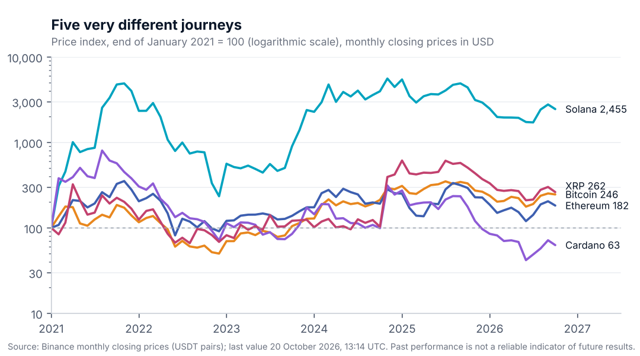
Technology is one thing, price performance another. Since 2021, the five assets have followed very different paths, and the result depends heavily on the period chosen. Measured from the end of January 2021, Solana is up roughly 24-fold, while Cardano is down by more than a third. Over the past twelve months, however, all five have fallen – from 25% in the case of Bitcoin to 66% in the case of Cardano.
Part Two: How Retail Investors Actually Decide
The comparison above is useful for anyone who can interpret it. But terms such as rollups, Proof of History, eUTxO or validator lists mean little to a typical retail investor. Survey data confirm that many newcomers enter the market through channels that have nothing to do with analysing fundamentals. A 2023 study by the CFA Institute and the FINRA Investor Education Foundation found that 44% of Gen Z investors in the United States made their first investment in crypto, 41% named fear of missing out (FOMO) as a reason for starting to invest, and social media was their most frequently used source of investment information (48%). Where technical knowledge is missing, the gap is filled by mental shortcuts and by the opinions of others.
The Price Illusion: Why a “Cheap” Coin Feels Like a Bargain
One of the most common – and most irrational – reasons for buying altcoins is the price of a single coin. Bitcoin costs tens of thousands of dollars, while many altcoins cost a few dollars or only a fraction of a dollar. For a retail investor, owning thousands of whole XRP or ADA tokens can feel more satisfying, and more promising, than owning 0.01 BTC. Behavioural economists call this unit bias: people tend to see one whole unit as the natural amount to own, regardless of what the unit is worth. In stock markets, a related effect called nominal price illusion has been documented: investors tend to overestimate how much low-priced shares can rise.
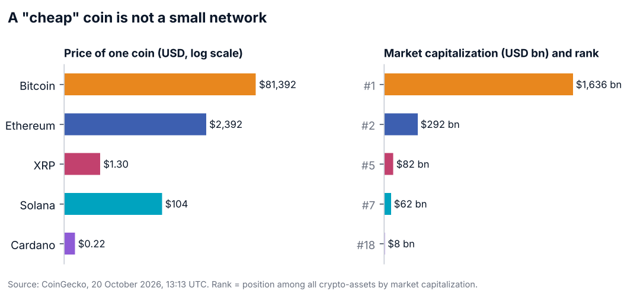
The problem is that the price of one coin says nothing about whether it is cheap or expensive. What matters is the value of the whole network – its market capitalization, which equals the price of one coin multiplied by the number of coins in circulation. Bitcoin's supply is capped at 21 million coins, while XRP has a maximum supply of 100 billion. A coin priced at one dollar is therefore no closer to the bottom than a coin priced at a hundred thousand dollars; for its price to rise tenfold, the whole network would have to become ten times more valuable. The chart below shows this clearly: one XRP costs about $1.30 and one SOL about $104, yet the XRP network is worth more in total than Solana. Cardano, the “cheapest” of the five at around $0.22, is also by far the smallest network.
The “Early Stage” Belief: Newer Coins Have Not Yet Peaked
A second widespread belief is that younger or smaller cryptocurrencies are still at an early stage, while Bitcoin has already delivered its biggest gains. The reasoning sounds intuitive: those who bought Bitcoin in 2013 or 2017 earned extraordinary returns; Bitcoin is now large and mature; so the next big win must come from somewhere else. Psychologists call this extrapolation, or representativeness bias: investors project the history of one successful asset onto others that merely look similar – often helped along by marketing labels such as “the next Bitcoin” or “the Ethereum killer”.
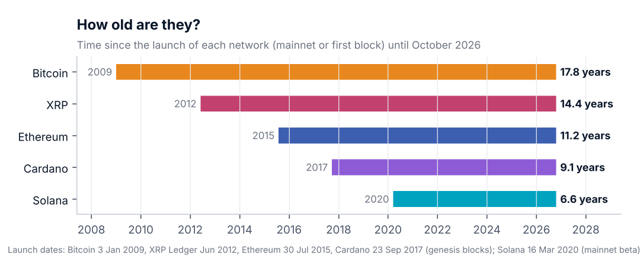
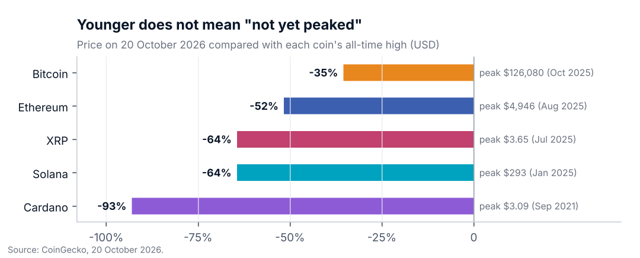
The belief ignores survivorship bias. Investors remember Bitcoin and Ethereum, but not the thousands of tokens from earlier cycles that lost most or all of their value, nor the projects that once ranked among the ten largest cryptocurrencies and have since dropped far down the rankings. A young project has not “not yet peaked”; it simply has not yet shown whether it will last. Higher potential gains go hand in hand with a much higher risk of failure. Current data do not support the idea that younger coins are automatically further from their peak either: Solana, the youngest of the five, and XRP, one of the oldest, are both about 64% below their record highs, Cardano is still 93% below the peak it reached in 2021, and Bitcoin, the oldest, is the closest to its all-time high.
Other Behavioural Drivers: FOMO, Lottery Thinking and Familiar Names
Fear of missing out and herding. Sharp price rallies attract media attention and social media buzz, which draw in new buyers precisely when prices are already high. Buying because “everyone else is buying” tends to mean buying near local peaks and selling in panic during corrections.
Lottery-like thinking. Some investors knowingly treat small, inexpensive coins as a lottery ticket: a small stake with a small chance of a huge payoff. Research on stock markets shows that retail investors systematically favour assets with lottery-like features, even though such assets have historically delivered weak average returns.
Familiarity and availability. Investors tend to buy what they see most often: coins at the top of exchange apps, in market-cap rankings or in news headlines. Visibility is easily mistaken for quality.
Stories instead of analysis. Even the technical features described in Part One often reach retail investors as simple stories (“banks will use XRP”, “Solana is the fast blockchain”). A story may contain some truth, but it does not tell the investor whether this is already reflected in the price.
The illusion of diversification. Holding five different coins may feel diversified, but crypto-assets tend to move together, especially when markets fall – as the past twelve months have shown. A portfolio made up only of crypto-assets remains, above all, a bet on the crypto market as a whole.
When Others Decide: Brokers, Advisers, Media and Influencers
Many retail investors do not choose altcoins themselves at all. They follow the recommendation of a crypto broker, an investment adviser, a specialized media outlet or an online personality. Relying on others is understandable when one lacks expertise, but investors should keep in mind that the risk stays with them, and that each of these sources has its own interests.
Crypto brokers and exchanges. The range of coins offered on a platform already shapes investors' choices; a listing can easily be read as an endorsement. Platforms also promote individual coins through campaigns, staking rewards (returns for locking coins in the network) or referral bonuses, and they typically earn on trading fees and spreads, which gives them an interest in active trading across many assets.
Regulation helps, but only up to a point. Since 1 July 2026, when the transitional period of the EU Markets in Crypto-Assets Regulation (MiCA) ended, firms need to be authorised or otherwise entitled to operate under MiCA to provide crypto-asset services to clients in the EU. MiCA sets clear rules on how these firms must operate: capital and governance requirements, safekeeping and segregation of client assets, management of conflicts of interest, complaint handling and supervision by a national regulator. What MiCA cannot do is guarantee investment results. European supervisors have repeatedly reminded consumers that crypto-assets remain risky, that MiCA does not cover all crypto-assets and services, and that its protection applies only to the authorised EU entity. A licensed provider is subject to regulatory requirements and supervision – this does not make the investment safe.
Investment advisers. A qualified adviser can help an investor decide whether crypto-assets belong in a portfolio at all and in what proportion. Under MiCA, firms that give advice on crypto-assets must check that the recommendation suits the specific client. Even so, investors should ask how the adviser is paid and whether commissions depend on the products recommended.
Crypto media. Specialized media are an important source of news, but part of the sector is financed by advertising from exchanges and token issuers, and the line between journalism, sponsored content and price predictions is not always clear to readers.
Finfluencers and social media. Online personalities who talk about investing (“finfluencers”) reach a large, young audience. Some promotions are paid without clear disclosure, and coordinated campaigns can be used to push up the price of small tokens before their promoters sell (pump-and-dump schemes). European and national regulators are therefore paying increasing attention to investment promotion on social media. Under MiCA, marketing communications for crypto-assets must be fair, clear and not misleading, and must be clearly identifiable as marketing.
Five Questions Before Buying an Altcoin
Retail investors do not need to become blockchain engineers. A few simple questions can, however, filter out the most common behavioural traps:
1. What does the network actually do? If you cannot explain in one or two sentences what the project is for and who uses it, you are buying a story, not an asset.
2. Am I looking at the market capitalization, not the price of one coin? A low price per coin is not a discount.
3. Why do I believe it has not yet peaked? “It is new” or “it is cheaper than Bitcoin” is not an argument.
4. Who benefits from my purchase? Find out whether the person or platform recommending the coin earns on the transaction, the listing or the promotion.
5. How much can I afford to lose? Speculative altcoin positions should be sized so that a total loss would not threaten your financial stability.
Summary
From a technological point of view, the major altcoins are genuinely different infrastructures: Ethereum as the main platform for decentralized finance, Solana for high-volume consumer and trading activity, Cardano for peer-reviewed security and decentralized governance, and XRP as a specialized bridge for cross-border payments. A well-informed investor can treat them as a complement to Bitcoin's role as a store of value.
Crypto4me's analysis highlights, however, that retail investors may buy altcoins for reasons other than these characteristics. They may respond to a low price per coin, to the belief that newer projects still have their best years ahead, to the fear of missing out, and to the advice of brokers, advisers, media and influencers whose interests may not fully match their own. Recognizing these behavioural and outside influences is the first step towards making altcoin investments a deliberate choice rather than an impulse.
About crypto4me
Crypto4me enables the purchase of all major cryptocurrencies, including bitcoin, ether and SOL. In line with the strict requirements of the EU MiCA licence, the company applies rigorous security measures for both trading and the safekeeping of cryptocurrencies in wallets, together with further safeguards such as multi-factor client authentication, encryption and regular penetration testing.
The crypto4me service is operated by Madison Six j. s. a., which has held an authorisation to provide crypto-asset services since 18 December 2025. The authorisation was granted by the National Bank of Slovakia under number 100-001-025-213 in accordance with the MiCA Regulation*. On the basis of this licence, the company may also provide crypto-asset services cross-border throughout the EU/EEA.
* Regulation (EU) 2023/1114 of the European Parliament and of the Council of 31 May 2023 on markets in crypto-assets, and amending Regulations (EU) No 1093/2010 and (EU) No 1095/2010 and Directives 2013/36/EU and (EU) 2019/1937.
Contact
Web: crypto4me.eu
E-mail: [email protected]
Phone: +421 905 886 681
Address: Madison Six j. s. a., Slávičie údolie 106, 811 02 Bratislava, Slovak Republic
Company ID (IČO): 56 856 229, registered in the Commercial Register of the Municipal Court Bratislava III, Section Sja, Entry No. 381/B
Sources
CFA Institute & FINRA Investor Education Foundation: Gen Z and Investing: Social Media, Crypto, FOMO, and Family (May 2023).
EBA, EIOPA and ESMA: joint warning to consumers on the risks of crypto-assets (6 October 2025); ESMA statement on the end of the MiCA transitional periods (June 2026).
Regulation (EU) 2023/1114 on markets in crypto-assets (MiCA).
Prices and market data: Binance (monthly closing prices) and CoinGecko, as of 20 October 2026.
Network data: ethereum.org, solana.com (Alpenglow), cardano.org, xrpl.org; Chainspect, The Block, YCharts, ETHBEAT (formerly L2BEAT), developers.cardano.org (2026).
SEC v. Ripple Labs: U.S. District Court for the Southern District of New York, ruling of 13 July 2023 and final judgment of 7 August 2024.
Important information
This study is for information and educational purposes only. It does not constitute investment advice, an investment recommendation or an offer to buy or sell any crypto-asset. Trading in crypto-assets is highly risky: their value can fluctuate significantly and you may lose some or all of the funds you invest. Past performance is not a reliable indicator of future results. Market data are as of 20 October 2026 and may have changed since. The protection provided by MiCA does not cover losses resulting from changes in the value of crypto-assets.
© 2026 Madison Six j. s. a. All rights reserved. Quoting from this study is permitted with reference to the source (crypto4me).

Crypto4me Supports Ice Hockey Club HC TEBS Bratislava
South Korea Wants to Resume Domestic ICOs. It Proposes Full Collateralization for Won-Denominated Stablecoins
On November 24, 2026, the South Korean Financial Services Commission (FSC) introduced a bill that would, after nine years, once again allow companies to raise capital through domestic initial coin offerings (ICOs). Before approaching investors, companies would have to disclose how the funds will be used and what risks buyers are assuming. The bill also regulates the issuance of stablecoins pegged to the South Korean won. Their issuers would be required to maintain full reserves and repurchase tokens upon the holder’s request. As of November 25, 2026, the bill is still awaiting approval by the National Assembly.