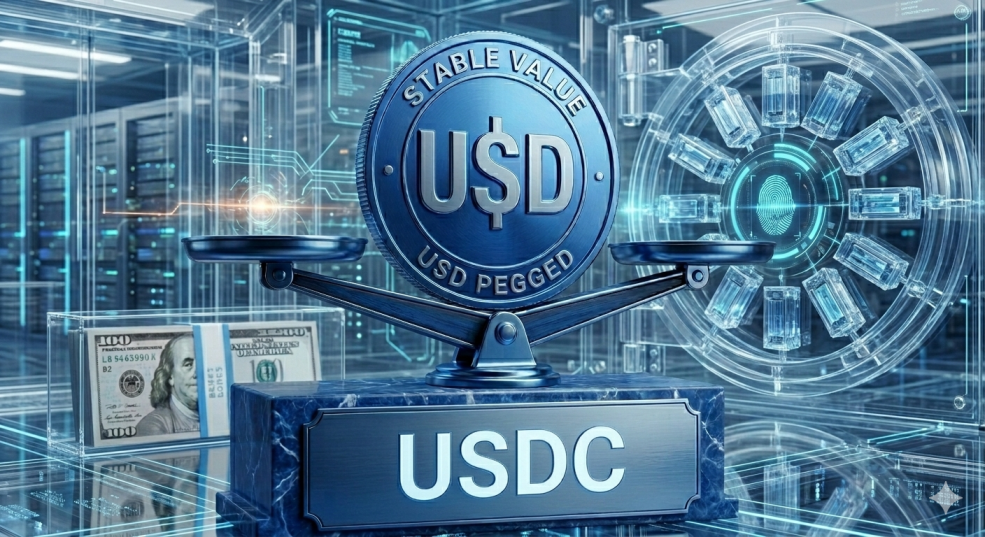
Stablecoins: What Are They, What Are They Used For and Why Use Them?
Can a digital dollar replace traditional banks? Stablecoins today move trillions of dollars annually, surpass payment giants and in some countries even substitute failing currencies. They combine the speed of blockchain with the stability of the U.S. dollar – yet at the same time raise questions about regulation, reserves and financial stability. What lies behind their growth and why are they reshaping the global financial order?
Architecture of the Digital Dollar
A stablecoin in its essence represents a technological hybrid that combines the lightning-fast infrastructure of blockchain with the stability of traditional state currencies, most often the U.S. dollar. Unlike Bitcoin, whose value is defined purely by supply and demand, the price of a stablecoin is artificially fixed to an underlying asset at a one-to-one ratio. This mechanism thus allows investors to hold digital value without being exposed to the risk that their purchasing power will disappear overnight. In practice, this means that if you send 100 USD in stablecoins to the other side of the world, the recipient will receive exactly the same value you sent, and within a matter of seconds.
Payment Giants in Numbers
The strength of stablecoins has fully manifested in recent years in their ability to compete with the world’s largest payment networks. The transaction volume in this segment reached 18.36 trillion USD in 2024, with stablecoins officially surpassing for the first time the processing volumes of giants such as Visa or Mastercard. This exponential growth is not accidental, but results from the search for a more efficient path for cross-border payments, where digital assets offer instant settlement and fractional fees compared to the decades-old correspondent banking system.
A Lifeline in Times of Hyperinflation
In countries where monetary policy fails, stablecoins have literally become a tool for financial survival. An example is Venezuela, which in 2025 faced extreme inflation at a level of 229 %, forcing millions of residents to abandon the devalued bolívar and switch to digital dollars. For the affected households, selected stablecoins in practice fulfill the function that state institutions in crisis regions have failed to ensure.
MiCA and a New Era of Regulated Security
The European market in 2026 is defined by the strict regulatory framework MiCA, which fundamentally cleared the space of risky projects. The world’s largest exchanges had to proceed in 2025 with the delisting of 9 unregulated stablecoins for users in the European Economic Area. This change also affected the popular Tether and forced investors to switch to fully audited and licensed alternatives such as USDC or EURI. For the end user, this means greater legal protection and certainty that the issuer truly holds the reserves it declares.
Architecture for a World After Banking Crises
Experiences from the collapse of Silicon Valley Bank have shown that even stable coins can be vulnerable if their reserves are too closely tied to traditional banks. This led to the development of innovative solutions such as the synthetic dollar USDe from the Ethena project, which builds stability not on bank deposits but on advanced financial strategies directly on the blockchain. This shift toward greater independence from the traditional financial sector creates a more resilient infrastructure that can function even in moments when traditional banking institutions face liquidity problems.

Zcash Votes on 50,000 ZEC. Development Funding and Faster Blocks Are at Stake
The Zcash (ZEC) cryptocurrency community is expressing its views through advisory votes on the future of the Zcash Community Grants (ZCG) program, a potential transfer of 50,000 ZEC, and a further reduction in the time between blocks. One of the main proposals envisages temporarily withdrawing this amount of coins from circulation and redirecting the grant program's future revenue to a new fund for development and legal defense. Voting closes on December 1, 2026, at 3:59 a.m. Slovak time. The results are intended to indicate the level of support for the individual proposals and serve as a basis for a potential NU7.1 network upgrade.

Traditional Finance Moves Toward Public Blockchain: DTCC to Enable Stock and Bond Tokenization on Solana
The Depository Trust Company (DTC), a subsidiary of U.S. clearing giant DTCC, plans to make its asset tokenization service available on the Solana network in the second half of 2027. The integration of an institution that manages securities worth USD 114 trillion represents an important step. However, the actual economic benefit for the SOL cryptocurrency will depend on the real volume of transactions generated, rather than the value of assets under custody. The public blockchain will also become part of a tightly controlled institutional ecosystem with permissioned access.