
Financial Reset 2026: Why cryptocurrencies are the only hedge against interest rate policy
The global economy has reached a point that history will likely mark as one of the greatest financial resets of the modern era. Traditional investment principles, on which generations of investors were raised, are no longer valid in an environment of extreme volatility. We stand in the middle of a transformation where passivity becomes the fastest path to losing wealth and where understanding the new rules of the game is not just an advantage, but a matter of survival for your capital.
The end of the era of cheap money
For many years, we lived in an artificially maintained environment of near-zero interest rates and massive liquidity. Money was “free,” which distorted the perception of real value and risk. However, this era is definitively over. Today, we face a new reality in which economic uncertainty is omnipresent and markets react to every move of central banks with unprecedented sensitivity. While most of the population is still waiting for a return to old standards, informed investors have already understood that cash in current accounts today does not represent a safe haven, but rather an asset that quietly and relentlessly loses its purchasing power due to systemic changes.
Inflation as an invisible tax on your success
The fundamental pillar of today’s financial crisis is inflation, which we must perceive in its purest form – as the devaluation of life energy stored in money. When central banks increase the money supply, the value of each unit of currency in circulation naturally declines. Inflation is not just an abstract number in statistics; it is a direct attack on your savings and the results of your long-term work. If your capital does not grow at a rate that significantly exceeds the rate of currency devaluation, you are effectively becoming poorer every day. Relying on traditional banking products in this environment means voluntarily accepting a negative real return and watching your purchasing power dissolve in favor of government debt.
The central banks’ game with interest rates
Interest rates today act as the only, yet very clumsy, tool to control the “temperature” of the economy. Raising them may theoretically curb inflation, but at the same time dramatically increases the cost of debt and suppresses economic growth. Conversely, lowering them stimulates markets but once again floods the system with new money, fueling another inflationary spiral. This balancing act creates an environment in which traditional assets such as bonds or real estate are under extreme pressure. For an investor, it is crucial to understand that this cycle is inevitable and, within the current system, practically unsolvable without someone (usually the average saver) paying the price.
Digital gold: Cryptocurrencies as a technological solution
In this disrupted system, cryptocurrencies, led by Bitcoin, have evolved into something far more important than just a speculative tool. They represent a technological response to the shortcomings of fiat currencies. Their main pillar is algorithmic scarcity, which cannot be influenced by political decisions or economic crises. Unlike the euro or the dollar, whose supply is essentially unlimited, the supply of leading digital assets is mathematically capped. This property makes them an ideal tool for preserving value at a time when traditional currencies are under constant pressure from money printing. Decentralization further ensures that your wealth is not directly dependent on the stability of a single bank or the political will of a state.
Strategic wealth protection in a new age
The shift from speculative trading to strategic asset allocation is now a necessity for anyone who wants to protect their wealth. A modern portfolio can no longer rely solely on stocks and cash. Including digital assets in an investment strategy brings what is known as asymmetric return potential – a situation where the growth potential driven by technological adoption is many times greater than the risk of losing the invested capital. It is not about betting everything on one card, but about intelligent diversification into assets that are not correlated with the mistakes of central authorities. Cryptocurrencies are a technology of money, and ignoring this trend in 2026 is the same mistake as ignoring digitalization three decades ago.
The future belongs to the prepared
History teaches us that wealth does not disappear during times of major crises – it only moves. It moves from those who hesitate and rely on old certainties to those who can recognize changing trends in time and adapt their actions accordingly. The greatest enemy of an investor today is not market volatility, but the loss of time. Waiting for the “perfect moment” or for the situation in traditional finance to calm down is the most expensive strategy you can choose. The financial reset is already underway, and your ability to take a decisive step toward digitalization and the protection of your savings will determine which side of this wealth transformation you end up on. Take responsibility for your financial freedom before the surrounding environment forces you to do so.

Tokyo takes the initiative: Three Japanese banks launch a joint stablecoin
Japanese banking houses MUFG, Mizuho, and SMBC are establishing a joint council with the aim of putting into circulation a unified stablecoin pegged to the yen. These three institutions jointly manage assets exceeding 7 trillion USD, making their initiative the largest institutional stablecoin project in Asia. The joint stablecoin is expected to enter live operation no later than March 2027 and definitively integrate blockchain infrastructure directly into the core of the traditional financial system.
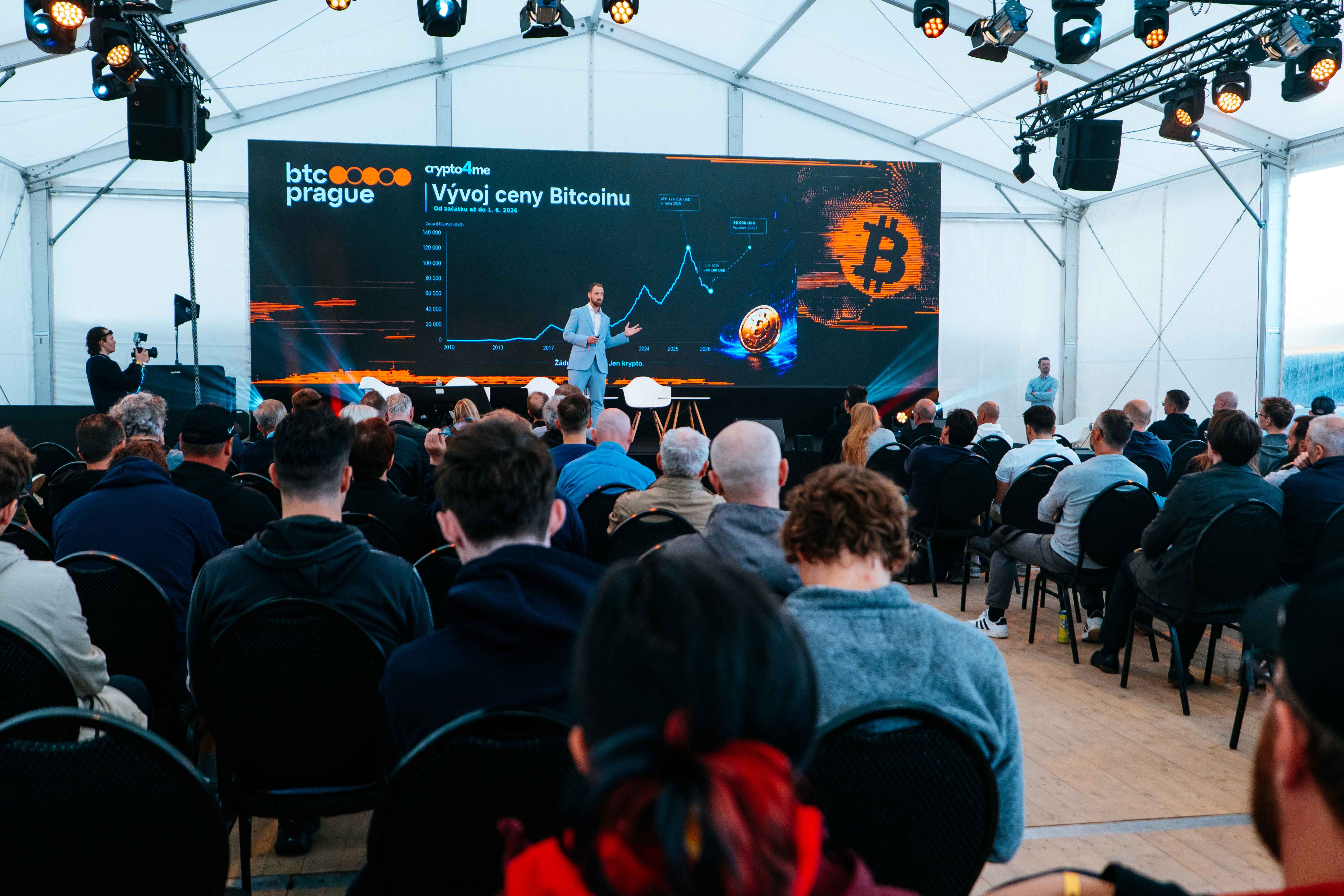
Crypto4me presented Plan ₿ to the European Bitcoin community at BTC Prague 2026
From June 11 to 13, 2026, the fourth edition of BTC Prague took place in Prague's Letňany district. One of Europe's most important Bitcoin conferences once again brought together experts, entrepreneurs, developers, investors, and members of the public interested in Bitcoin.