Bitcoin Mining: What It Is and How It Works?
Bitcoin may seem like a purely digital thing, but in the background, it has a system that must continuously confirm transactions and protect itself against fraud. That is exactly what bitcoin mining is for. It is a mechanism that keeps the network functioning without a central authority, ensures a shared and trustworthy history of transactions, and also determines how new blocks are created.
What Mining Is
Bitcoin mining is a process in which specialized computers verify transactions and add them to the blockchain. In practice, miners provide the network with a service that replaces the role of a central institution by deciding which transactions become a definitive part of the shared history. Their most important role is security, because mining prevents double-spending and makes attempts to manipulate the past more difficult. It also helps the network reach consensus, meaning agreement on which version of the blockchain is the correct and current one. Mining, therefore, connects the technical part of verification with the economic incentive that makes it worthwhile to act honestly.
How Blocks Are Made
When users send bitcoin, transactions first spread through the network and wait to be included in a block. Miners select transactions, typically also based on the fees they include, and assemble a candidate block from them. Before they even try to add the block to the blockchain, they must verify whether the transactions are valid, whether the signatures match, and whether the sender is really spending available coins. They also add a special transaction to the block that assigns them the reward, but it will be recognized only if the network accepts the block. When the block is ready, a competition begins over who can first make it acceptable according to the Proof of Work rules. If it succeeds, the block is broadcast to the network, and other nodes check it independently.
Proof of Work
Proof of Work is the way the network chooses the next block so that it is fair and also secure. Miners search for a value that causes the result of the computation to have the required properties, and it is a search by trial and error. Finding the correct result is difficult and requires many computations, but verifying it is very fast, which is practical for the network. The purpose is that adding a block has a real cost in the form of work and energy, so an attack on the network would be economically extremely expensive. If someone tried to rewrite history, they would have to recompute an enormous amount of work and, at the same time, catch up with honest miners who continue forward. The difficulty is adjusted regularly so that blocks are created at roughly the same pace, even when computational power is added to or removed from the network.
Rewards and Fees
Miners are motivated by the fact that for creating a valid block, they receive a reward. It consists of new bitcoins that are created according to the network rules, and transaction fees paid by users. Fees also function as a natural prioritization mechanism because when there is greater demand for transactions, those that offer a higher fee typically get into a block sooner. The portion of the reward in the form of new bitcoins gradually decreases, which slows the growth of supply, and over time, the system relies more on fees. From a security perspective, miners must have an economic reason to follow the rules, because if they created a block incorrectly, the network would reject it, and they would not get the reward. This combination of rewards and the penalty in the form of zero profit keeps the whole mechanism stable even without central management.
Hardware and Energy
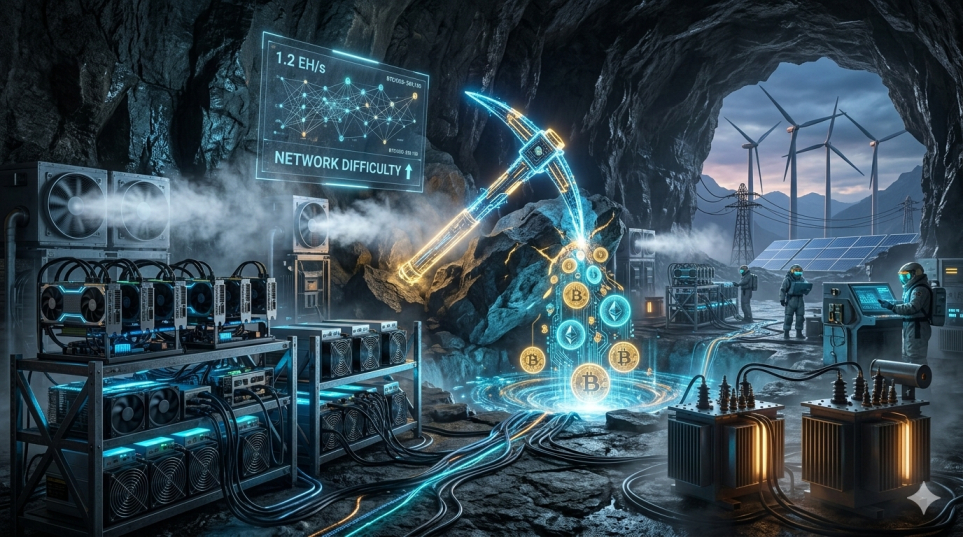
Mining today is carried out mainly using specialized devices that are designed to perform the computations for Proof of Work as efficiently as possible. An ordinary home computer can no longer compete in practice because performance and energy efficiency are the deciding factors. Energy consumption is a natural consequence of the fact that Proof of Work must be demanding, otherwise the security barrier would not work. Miners therefore track the price of electricity, hardware efficiency, cooling costs, and operational stability, because profitability is a combination of these factors and the value of rewards and fees. In practice, farms arise in areas where electricity is cheaper or where surplus energy is available, while the market pushes miners toward increasingly efficient solutions. The result is that mining is not only a technical process, but also an economic competition that directly affects the security of the entire Bitcoin network.

Hyperliquid Appears on Bloomberg Terminal
Perpetual contracts from the decentralized derivatives platform Hyperliquid have appeared in the Bloomberg Terminal data environment. The DeFi protocol has therefore crossed an important threshold toward greater visibility among professional investors. However, the listing of data itself does not automatically mean that traditional financial institutions are beginning to trade on the platform.

How Does Vitalik Buterin Want to Change Ethereum by 2030?
Ethereum founder Vitalik Buterin has presented his long-term vision for the world’s second-largest cryptocurrency. By 2030, the network is intended to transform into a so-called cryptographic world computer. The foundation of the entire change is to move away from the existing model, in which every computer repeats the same calculations, and replace it with fast mathematical proofs and stronger privacy protection.